
- Bestowment allows an organization that is already incorporated under another law the chance to acquire status without having to re-register.
- The organization retains its original legal identity after bestowment.
- The Authority must be satisfied that the organization genuinely serves public benefit purposes.
- The public benefit test under the Regulations applies equally to applications for as well as for bestowment.
- Organizations granted bestowment enjoy the rights and benefits of PBOs while acquiring the governance, reporting and accountability obligations applicable under the Act.

Knowledge hub
Bestowment of Public Benefit Organization Status
Listen to this page
Prefer listening? Play to hear this topic read in a clear voice.
At a glance
Read the full explanation
Bestowment of Public Benefit Organization Status
How Existing Organizations Can Acquire Public Benefit Organization Status under the Public Benefits Organizations Act, 2013 and the PBO Regulations, 2026
Why this Summary Matters
Kenya's nonprofit sector is diverse, with many organizations pursuing public benefit objectives. Some nonprofit organizations (NPOs) are legally incorporated under the Public Benefit Organizations () Act, while others are registered under laws such as the Companies Act, the Trustees (Perpetual Succession) Act, the Societies Act and the Community Groups Act. Although these organizations already have legal personality, they may wish to receive the benefits, and recognition offered under the Public Benefits Organizations Act, 2013.
To facilitate this, the Act introduces the concept of “bestowment of status”. This approach allows an existing organization to retain its original legal identity while being formally recognized as a , without the need to dissolve and re-register under the .
The Act provides the legal basis for this bestowment process, while the Public Benefits Organizations Regulations, 2026 prescribe the application procedure, documentation, timelines and forms.
What is Bestowment of Public Benefit Organization Status?
Bestowment of Status is the legal process through which the Authority formally grants public benefit status to nonprofit organizations incorporated under other laws, such as the Companies Act. This means that NPOs that are not registered as PBOs may still be recognized by the Authority as public benefit organizations.
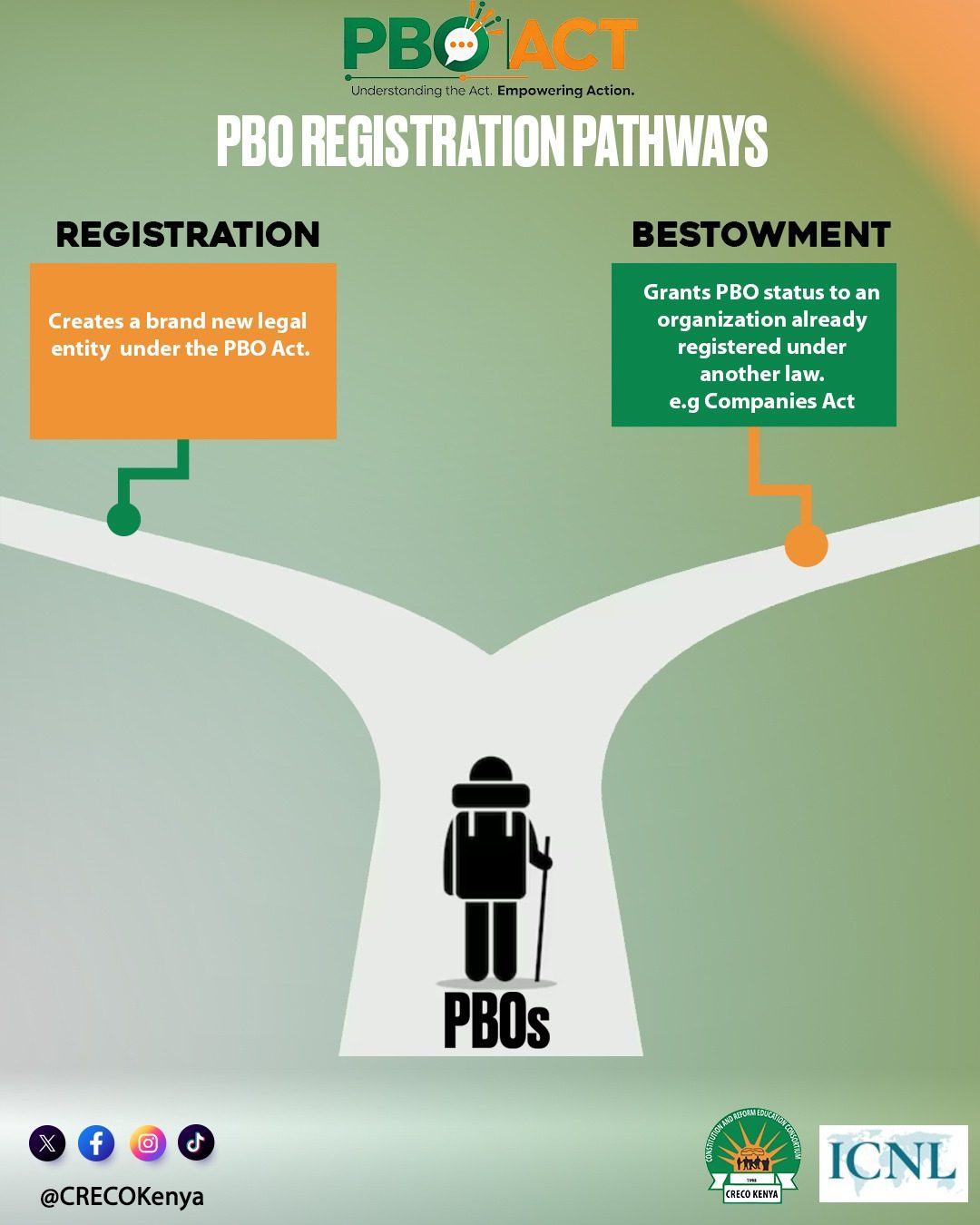
Distinction between Registration and Bestowment
Unlike under Part II of the Act, bestowment does not create a new legal entity. Instead, it grants an organization that is carrying out public benefit activities, the status of , even though it is registered under another law.
In simple terms:
- creates a new legal entity – -] under the Act.
- Bestowment grants status to an organization that already exists under another law.
This distinction is important because the legal identity of the organization remains unchanged after bestowment.
Why Seek Bestowment of Public Benefit Status?
An organization may seek bestowment for several reasons.
- Legal recognition: It allows the organization to acquire legal recognition as no organization may claim to be a or receive the benefits of status unless it is registered under the Act or has been granted status by the Authority.
- Access to benefits: It enables the organization to access the rights, privileges and benefits available to PBOs under the Act, including eligibility for incentives and recognition under the PBO legal framework, subject to applicable laws.
- Public confidence: Bestowment demonstrates that the organization has met the standards of governance, accountability and public benefit required under the Act, thereby enhancing public confidence among donors, partners, beneficiaries and government institutions.
Which Organizations May Apply for Bestowment?
Section 7 of the Act provides that an organization incorporated under another written law may apply to the Authority for the bestowment of status, provided it satisfies the requirements prescribed under the Act.
The Regulations further clarify that an eligible organization must be:
- incorporated under a relevant Kenyan law;
- be in good standing with its current registering body;
- not fall within the excluded categories under section 5(2) of the Act,
- have been operating in or from Kenya and undertaking a public benefit activity for at least three years;
- and have a governing body of at least three persons or directors, one-third of whom must be Kenyan nationals residing in Kenya.
Eligible organizations may include:
- companies limited by guarantee;
- trusts incorporated under the Trustees (Perpetual Succession) Act; and
- other non-profit legal entities established under Kenyan law whose primary purpose is to undertake public benefit activities and which are not excluded under section 5(2) of the Act.
The organization must be incorporated under a relevant Kenyan law and must also show that its purposes, activities, governance and track record satisfy the Act and the Regulations.
Application Procedure
The Regulations prescribe the procedure for applying for bestowment.
An application must be submitted to the Public Benefits Organizations using the prescribed form in the Second Schedule and accompanied by the prescribed fee.
The following documents must accompany the application:
- the certificate of incorporation or under the relevant law;
- the governing instrument, such as its constitution, trust deed or memorandum and articles of association;
- minutes of the meeting containing the resolution to seek status
details of the members of its governing body or officials;
- the entity’s registered and physical addresses; and
- ;
Three years of audited accounts These documents enable the Authority to determine whether the organization satisfies the legal requirements for bestowment.
Conditions for Bestowment
The Act requires the Authority to be satisfied that the applicant genuinely qualifies as a . Although an organization may already be incorporated under another law, it is not automatically entitled to status.
The Authority must still apply the public benefit test contained in Regulation 6.
Accordingly, the Authority considers whether:
- the organization's activities fall within recognised public benefit areas;
- the activities directly provide a genuine benefit to the public or a section of the public;
- beneficiaries can be clearly identified; and
- the organization does not improperly benefit directors, their immediate family members or close business associates.
This ensures that only organizations genuinely serving the public interest receive status.
Assessment by the Authority
Upon receiving a complete application, the Authority examines whether the applicant meets the requirements of both the Act and the Regulations. In particular, the Authority considers:
- the organization's legal status: whether it is established as a nonprofit organization;
- its governing documents;
- whether its objectives are exclusively or primarily public benefit objectives;
- whether its governance arrangements promote accountability;
- whether it satisfies the public benefit test; and
- whether all prescribed documentation has been submitted
If additional information is required, the Authority may request clarification or supporting documentation before making a decision.
Grant of Bestowment
Where the Authority is satisfied that all legal requirements have been met, it grants the organization status and issues the prescribed certificate.
The certificate serves as official confirmation that the organization has received status under the while retaining its original legal incorporation.
Unlike organizations registered directly under the Act, the organization continues to derive its legal personality from the law under which it was originally incorporated.
Legal Effect of Bestowment
Bestowment has important legal consequences.
The organization:
- retains its existing legal identity;
- continues to be governed by its incorporating statute except where the imposes additional obligations;
- becomes subject to the oversight framework established under the ;
- acquires the rights and benefits available to Public Benefit Organizations under the Act; and
- assumes the reporting and accountability obligations applicable to PBOs.
Can Bestowment Be Refused?
Yes. The Authority may refuse an application where the organization fails to satisfy the requirements of the Act or the Regulations.
Examples include where:
- the organization's purposes are not public benefit purposes;
- its governing documents permit distribution of profits to members;
- its activities primarily benefit private persons;
- governance arrangements are inconsistent with the Act; or
- the prescribed documents have not been submitted.
When the application is refused, the principles of fair administrative action require that the applicants are informed of the reasons for the decision. and afforded the remedies available under the Act.
Responsibilities after Bestowment
Receiving status is not the end of the process. An organization granted bestowment must comply with the obligations imposed under the Act and the Regulations, including:
- maintaining appropriate governance structures;
- submitting annual reports and financial statements where required;
- notifying the Authority of material changes;
- complying with lawful directions issued under the Act; and
- continuing to operate for public benefit purposes.
Failure to comply may result in regulatory action, including suspension or cancellation of status, as discussed in Summary 7.
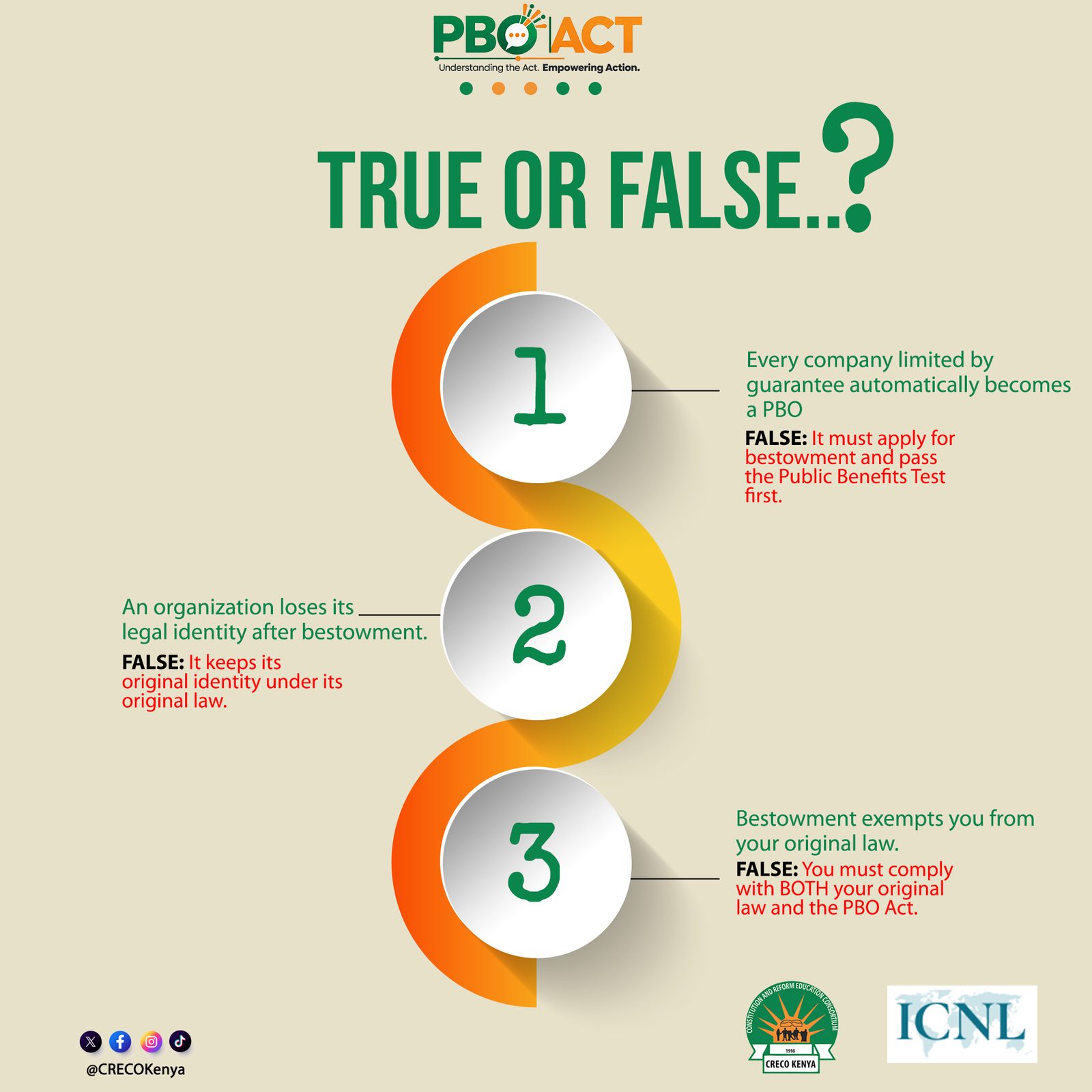
Common Misconceptions: Is it true that...
"Every company limited by guarantee automatically becomes a PBO?"
No. A company limited by guarantee that would like to obtain Status must first apply for bestowment and satisfy the requirements of the Act and the Regulations before acquiring status.
"An organization loses its legal identity after Bestowment?"
No. The organization retains its original legal status under the relevant law. Bestowment confers recognition of its status as a .
"Bestowment exempts an organization from complying with its original law?"
No. The organization must continue to comply with the law under which it was incorporated as well as the applicable provisions of the .
Practical Tips
Before applying for bestowment:
- Review your governing documents to ensure they reflect public benefit purposes.
- Confirm that your activities meet the requirements under the public benefit test.
- Ensure your governance arrangements comply with the standards expected under the Act.
- Prepare all necessary incorporation documents and supporting records.
- Verify that your constitution or trust deed contains a non-distribution clause.
- Ensure your records show that you are engaged in ongoing public benefit activities.
Legal References
Public Benefits Organizations Act, 2013: Section 7 (Bestowment of Status).
Public Benefits Organizations Regulations, 2026: Regulations 6, 9 and 10 (Public Benefit Test, Eligibility for Bestowment and Application for Bestowment), including Form 3 and Form 4 in the Second Schedule.
This summary is general information, not legal advice. Read it with the Public Benefit Organizations Act, 2013 and the Public Benefit Organizations Regulations, 2026.