Understanding the Public Benefits Organizations Legal Framework in Kenya
Listen to this page
Prefer listening? Play to hear this topic read in a clear voice.
At a glance
The Public Benefits Organizations Act, 2013 is the primary law governing Public Benefit Organizations in Kenya.
The Regulations, 2026 provide the procedures for implementing the Act.
A must be voluntary, autonomous, not for profit making and engaged in recognized public benefit activities.
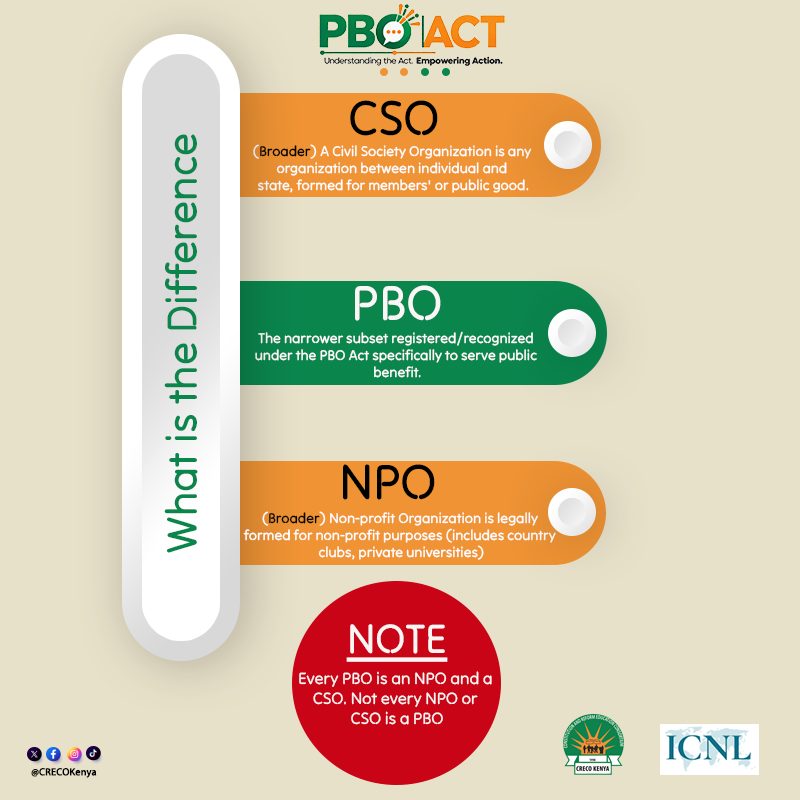
Not every not-for-profit organization automatically qualifies as a .
Government has a statutory duty to create an enabling environment for PBOs.
The legal framework promotes transparency, accountability, self-regulation and partnership rather than restrictive control.
Understanding the distinction between the Act and the Regulations is essential for with Kenya's legal framework.
Important Legal Update on Transition: NGOs that were registered under the repealed NGO Coordination Act will not lose their legal status simply because they have not registered a fresh under the . In the case of Otieno & 2 others v Attorney General & another (2025), the High Court decided that Paragraph 5(1) and 5(2) of the Fifth Schedule to the Public Benefit Organizations Act, 2013 are unconstitutional as they would violate Article 36 of the Constitution, which protects the freedom of association. Therefore, validly registered NGOs (national and international) will automatically be recognized as PBOs without needing to re-register under the . They will however need to provide updated information about their organisations and meet the transition requirements outlined in the Regulations, Rule 43. The deadline for with the transition provisions is May 13, 2027.
Understanding the Public Benefits Organizations Legal Framework in Kenya
What is the Public Benefits Organizations Act and Who Does It Apply To?
Why this Summary Matters
The Public Benefits Organizations Act, 2013 — “the Act” for short — fundamentally changed how Kenya regulates civil society organizations (CSOs). Rather than treating CSOs primarily as entities to be controlled, the Act establishes an enabling legal framework that recognizes the contribution of public benefit organizations (PBOs) to national development, democracy, human rights, public service delivery and social welfare. It also creates a modern regulatory system founded on transparency, accountability, self-regulation and partnership between Government and civil society
The Public Benefits Organizations Regulations, 2026 — “the Regulations” for short — operationalize the Act by providing the practical procedures, forms, timelines, fees and administrative requirements necessary to implement the law. Together, the Act and the Regulations provide the complete legal framework governing , operation, oversight and regulation of PBOs in Kenya.
This summary explains what the law is, whom it applies to and how the Act differs from the Regulations.
The Difference between the Act and the Regulations
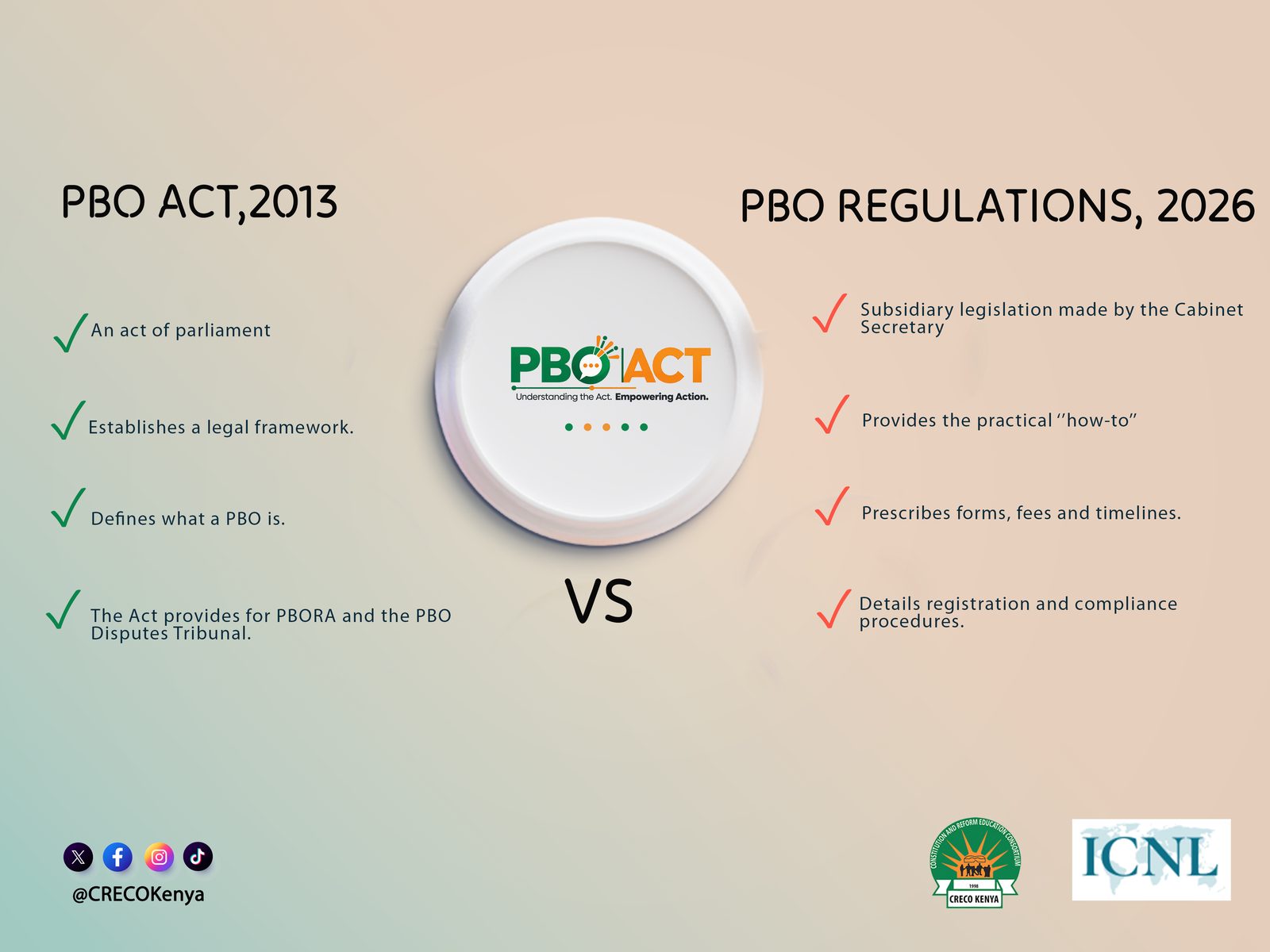
One of the most common misconceptions is that the Act and the Regulations are the same document. They are not.
The Public Benefits Organizations () Act, 2013 is an Act of Parliament. It establishes the legal framework by defining what a is, creating the Public Benefits Organizations (“the Authority”), establishing the Tribunal, setting out the rights and obligations of PBOs, and providing the legal powers under which the sector is regulated.
The Public Benefits Organizations Regulations, 2026 are subsidiary legislation made by the Cabinet Secretary through powers given under section 69 of the Act. Their purpose is to prescribe detailed rules necessary to implement and enforce the Act, including procedures, application forms, documentary requirements, fees, timelines and administrative processes. They do not replace the Act; rather, they give practical effect to it.
In simple terms:
The Act establishes the law.
The Regulations explain how the law is implemented.
Whenever there appears to be uncertainty between the Act and the Regulations, the Act takes precedence because it is the parent legislation, which creates and determines the Regulations’ limits. This means that subsidiary law must always follow the parent law that created it. If it goes beyond that power, a court can cancel it.
Why Was the PBO Act Enacted?
The recognizes that public benefit organizations are essential partners in Kenya's development. The preamble acknowledges that these organizations contribute to the public through various means, including public service delivery, democratic governance, accountability, social cohesion, environmental protection, and the realization of constitutional rights. It also recognizes that neither Government nor the private sector can, on their own, address every societal challenge.
Section 3 therefore establishes several key objectives of the Act, including:
creating an enabling environment for PBOs;
protecting the freedoms of association, expression and peaceful assembly;
promoting good governance, transparency and accountability;
encouraging self-regulation within the sector;
facilitating collaboration between Government, donors, business and civil society;
providing transparent procedures; and
strengthening civil society's contribution to Kenya's development.
These objectives distinguish the from the repealed NGO legal framework by placing greater emphasis on facilitating PBOs, rather than controlling them.
Government's Responsibility under the Act
The Act does not impose obligations only on PBOs. It also places responsibilities on Government.
Section 4 provides that Government has a duty to create and maintain an enabling environment in which PBOs can be established and operate freely, consistent with the constitutional freedoms of association and assembly. Every State organ must coordinate its policies in a manner that supports rather than hinders the work of PBOs. Government and PBOs are also expected to collaborate in accordance with the principles set out in the First Schedule to the Act.
This provision reflects the philosophy that civil society and Government are partners in advancing the public interest.
What is a Public Benefit Organization?
Section 5 provides the legal definition of a ().
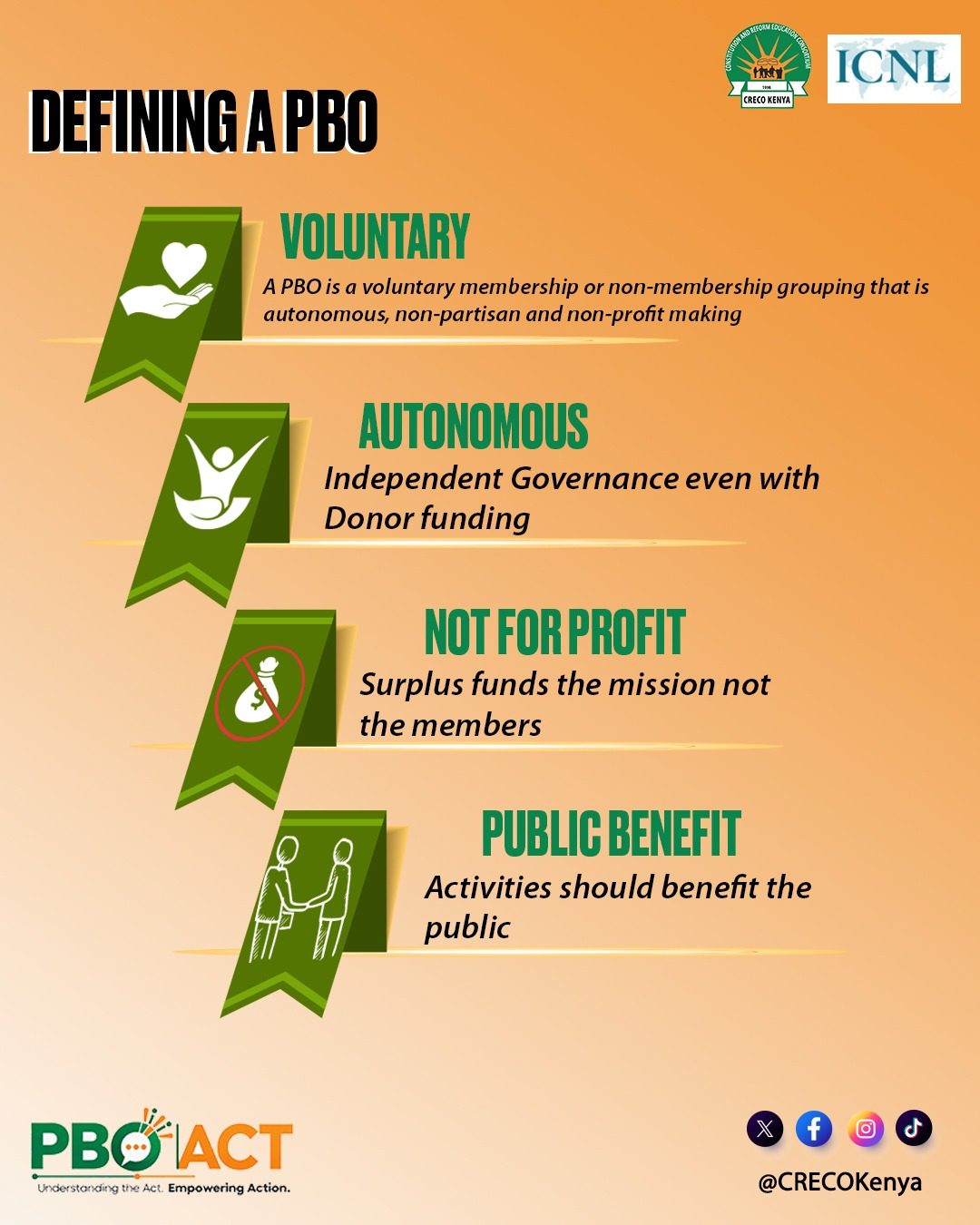
A is a voluntary membership or non-membership organization that is:
autonomous;
non-partisan;
not established for profit;
organized locally, nationally or internationally;
engaged in public benefit activities listed in the Sixth Schedule; and
registered by the Public Benefits Organizations , known as “the Authority”.
Several important elements emerge from this definition.
Voluntary — Participation must be voluntary. Individuals cannot be compelled to become members.
Autonomous — The organization must be independent in its governance and decision-making, even where it receives Government or donor funding.
Not established for profit — A may generate income, charge fees or undertake economic activities permitted by law, but any surplus must be used to further its public benefit purposes rather than being distributed to members or directors.
Public Benefit Activities — The organization's activities must benefit the public or a section of the public rather than private individuals.
What are Public Benefit Activities?
The Act defines a public benefit activity broadly to include activities that promote economic, social, environmental or cultural development, protect the environment, or advocate on issues affecting the public interest or the wellbeing of communities.
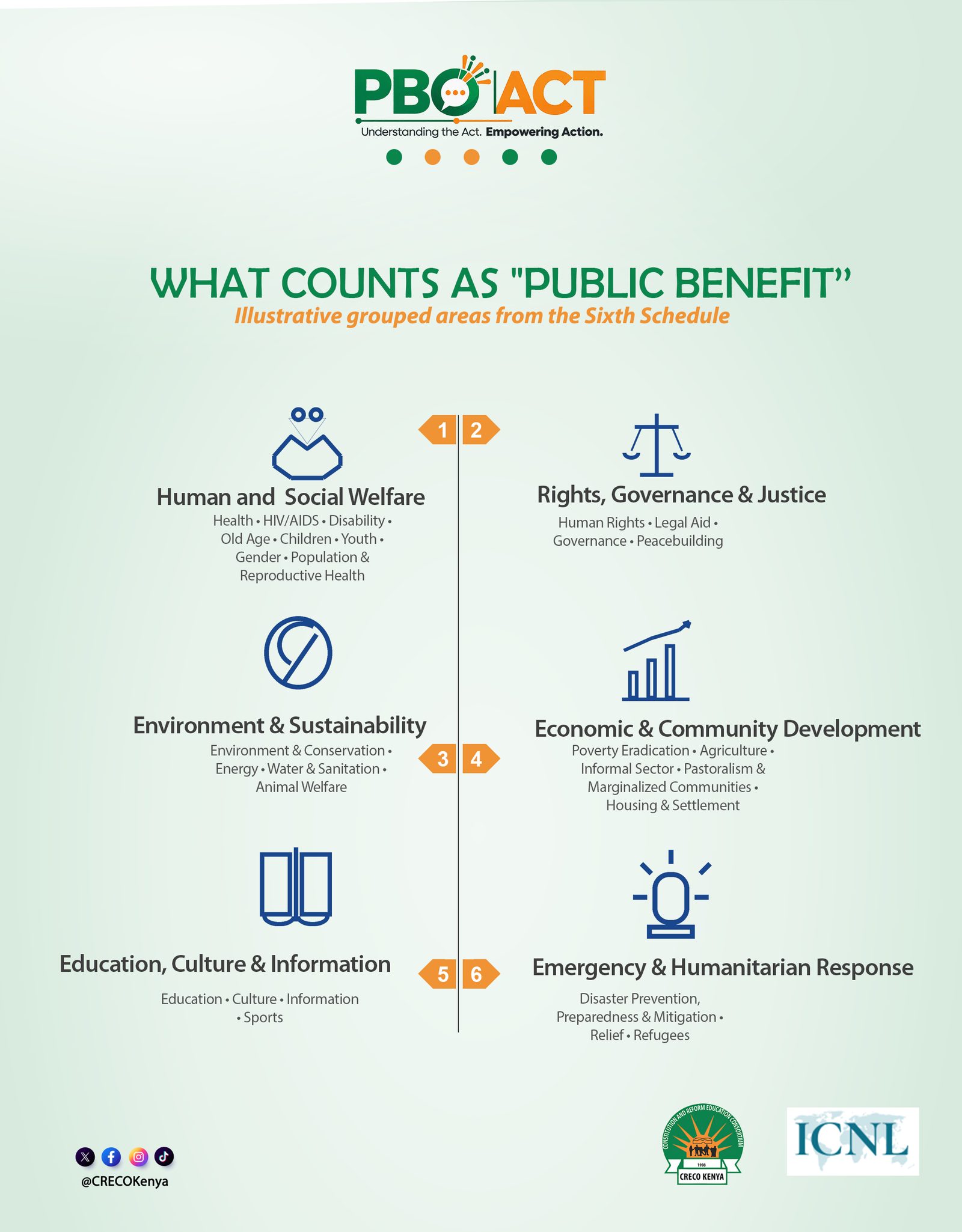
The Sixth Schedule contains a specific list of recognized public benefit areas. These include legal aid, agriculture, children, culture, disability, energy, education, environment and conservation, gender, governance, poverty eradication, health, housing and settlement, human rights, HIV/AIDS, information, the informal sector, old age, peace building, population and reproductive health, refugees, disaster prevention, preparedness and mitigation, relief, pastoralism and marginalized communities, sports, water and sanitation, animal welfare and youth.
The Regulations further introduce a "public benefit test" under Regulation 6(1), which an organization's activities must meet to be registered. To qualify, the activities must:
fall within the public benefit areas recognized under the Act, Section 2 and Schedule 6;
have identifiable beneficiaries;
produce genuine public benefit;
ensure that the benefit provided is directly related to the public benefit purpose and is not merely incidental or unexpected.
avoid conferring private benefits on directors, their immediate family members or close business associates.
Organizations that are NOT PBOs
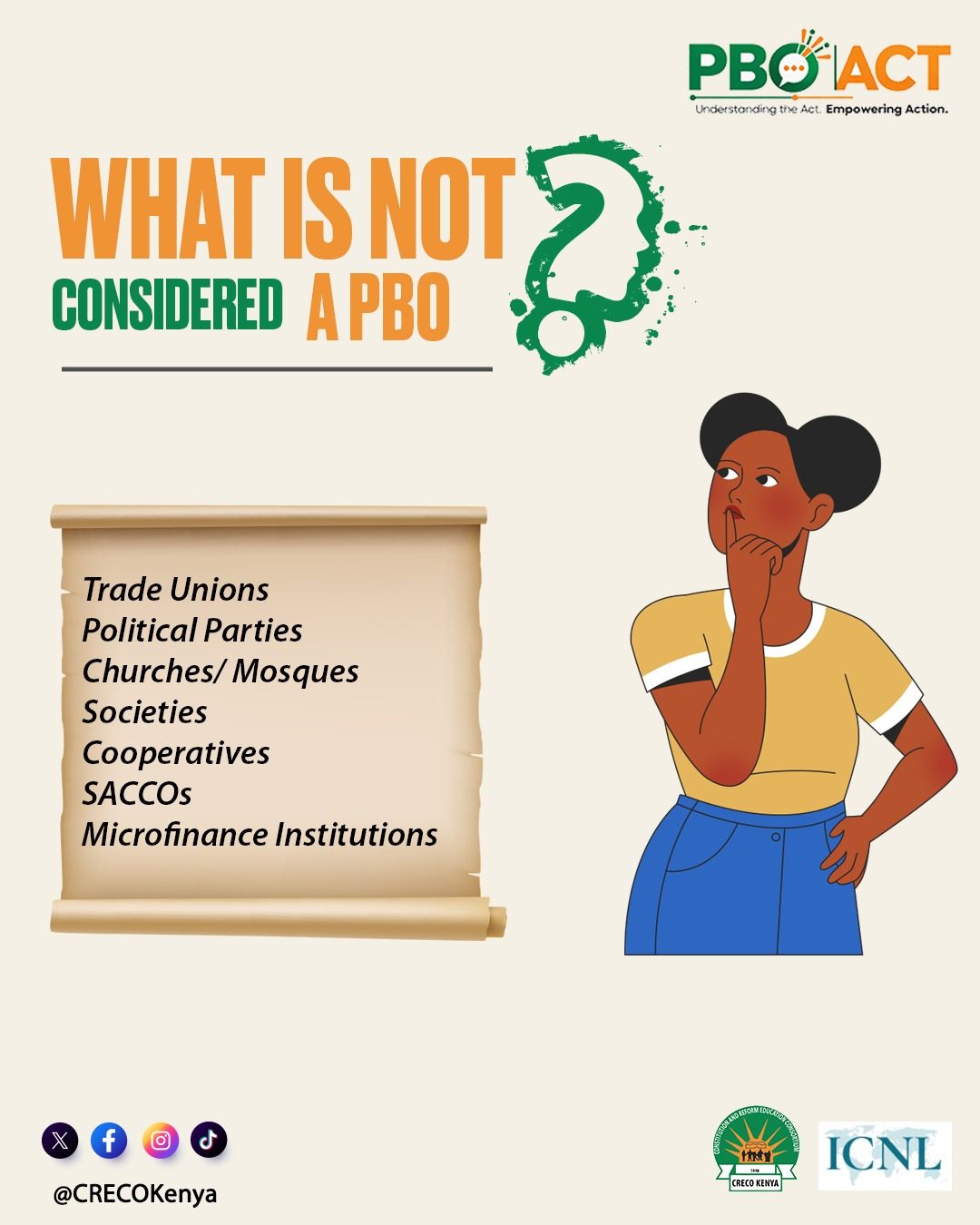
Not every organization that is non-profit organization qualifies as a .
Section 5(2) expressly excludes several entities, which exist to advance the interests of their members, including:
trade unions;
public bodies established by law;
political parties;
religious organizations primarily devoted to worship or religious teaching;
societies registered under the Societies Act;
cooperative societies;
SACCOs;
microfinance institutions; and
community-based organizations established primarily for the direct benefit of their own members.
Who Does the Act Apply To?
The legal framework applies to several entities. These include:
Organizations seeking directly as Public Benefit Organizations under the Act.
Organizations already incorporated under another Kenyan law that wish to obtain status through bestowment.
International organizations operating in or from Kenya.
Self-regulation forums and federations recognized under the Act.
The Public Benefits Organizations and the Public Benefit Organizations Disputes Tribunal established under the Act.
The Regulations provide separate procedures regarding each of these entities.
Rights-Based Approach
A notable feature of the Act is that it adopts a rights-based rather than permission-based approach. It recognizes that freedom of association is a constitutional right. is meant to provide legal recognition, ensure accountability and build public confidence - not to prevent legitimate civic activities. The Act also aims to safeguard internationally recognized freedoms of expression, association and peaceful assembly while establishing transparent regulatory procedures.
What the Regulations Do
While the Act establishes the legal framework, the Regulations provide the practical details needed to implement it.
Among other things, the Regulations prescribe:
how to search for and reserve names;
what qualifies as prohibited names;
the public benefit test;
application forms;
required supporting documents;
fees;
timelines for decision-making;
certificates and permits;
cancellation of ;
reporting requirements;
recognition of self-regulation forums;
notification of material changes; and
electronic submissions.
The Regulations ensure that provisions of the Act can be implemented consistently.
Legal References
Public Benefits Organizations Act, 2013: Sections 2–5, including Section 3 on objects, Section 4 on government responsibility and Section 5 on the meaning of a ; Sixth Schedule.
Public Benefits Organizations Regulations, 2026: Regulations 1–6, covering citation, interpretation, objects, name reservation, prohibited names and the public benefit test.