
- under the creates a distinct legal status as a .
- begins with reservation of the proposed name.
- Applicants must satisfy requirements in both the Act and the Regulations.
- A compliant constitution is central to successful .
- The Act provides the Authority with a time limit of 60 days to consider an application for .
- gives the organization corporate legal personality and the ability to own property, enter contracts and operate throughout Kenya.
- The Act guarantees procedural fairness where is delayed or refused.

Knowledge hub
Registration of Public Benefit Organizations
Listen to this page
Prefer listening? Play to hear this topic read in a clear voice.
At a glance
Read the full explanation
Registration of Public Benefit Organizations
How to Register a Public Benefit Organization under the Public Benefits Organizations Act, 2013 and the PBO Regulations, 2026
Why this Summary Matters
is the legal process through which an organization gains official recognition as a () under Kenyan law. gives an organization legal personality under the , enabling it to enjoy the rights, protections and benefits provided to legal entities by the law, while also assuming the responsibilities and obligations applicable to registered PBOs.
The Public Benefits Organizations Act, 2013 establishes who may register, the legal requirements for , and the Authority's powers in considering applications. The Public Benefits Organizations Regulations, 2026 complement the Act by prescribing the practical procedures, forms, supporting documents, timelines and fees required for .
This summary explains the process from start to finish.
Registration under the PBO Act
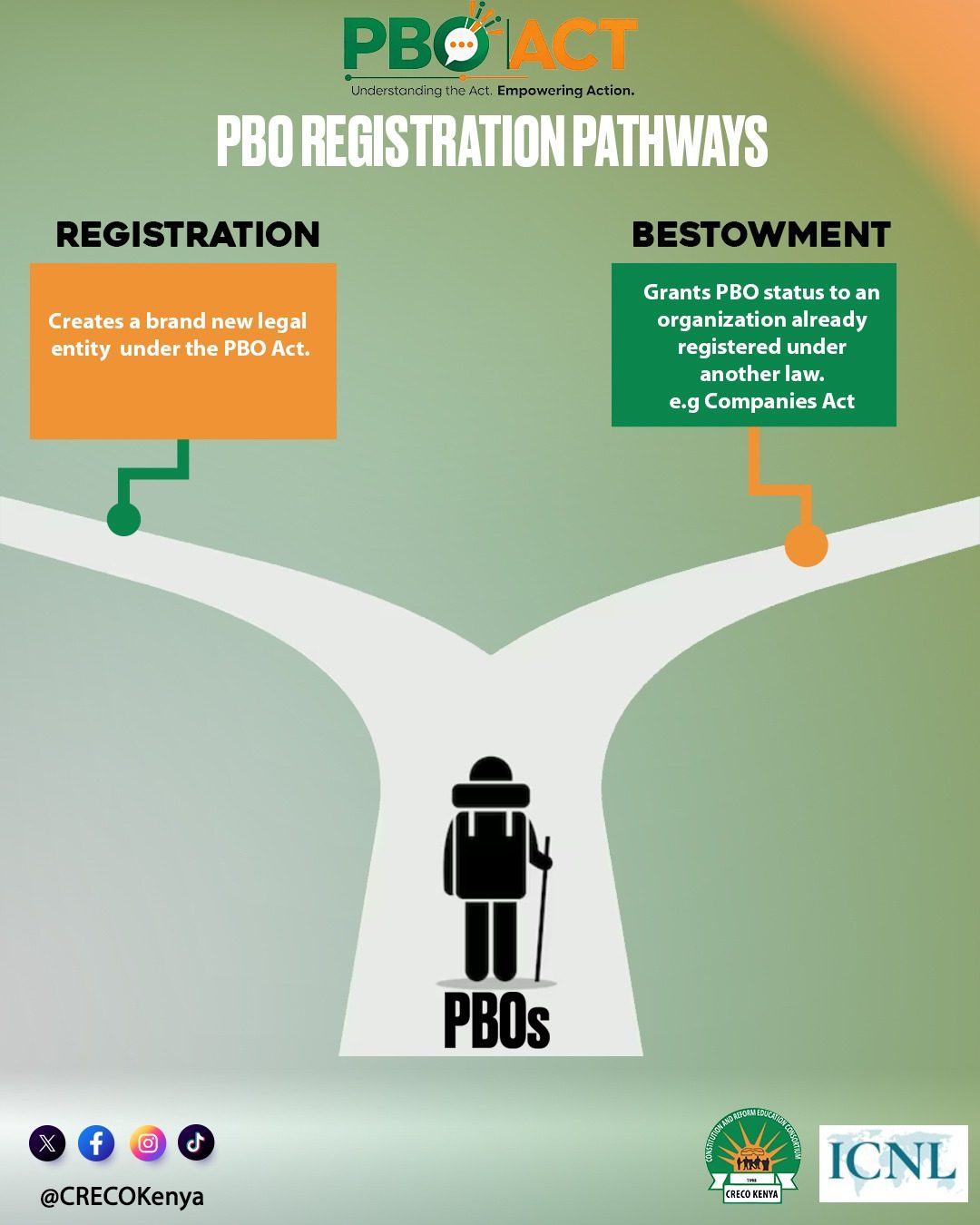
Section 6 of the Act provides that in order to enjoy the rights and benefits available under the Act, an organization must register under it. Upon under the Act, an organization gains a distinct legal status as a .
It is important to note that an organization cannot be registered under both the and another Kenyan law at the same time. Once an organization is registered under the , this takes priority and supersedes any previous registrations which become invalid. The Act in section 7, however, grants the Authority the power to bestow status to an organization that is registered under another law.
Who Can Apply for Registration?
An organization may apply for as a if it:
- is established for public benefit purposes;
- intends to undertake public benefit activities recognised under the Act;
- satisfies the constitutional and governance requirements prescribed by law; and
- complies with the requirements set out in the Act and the Regulations.
The process consists of the following stages:
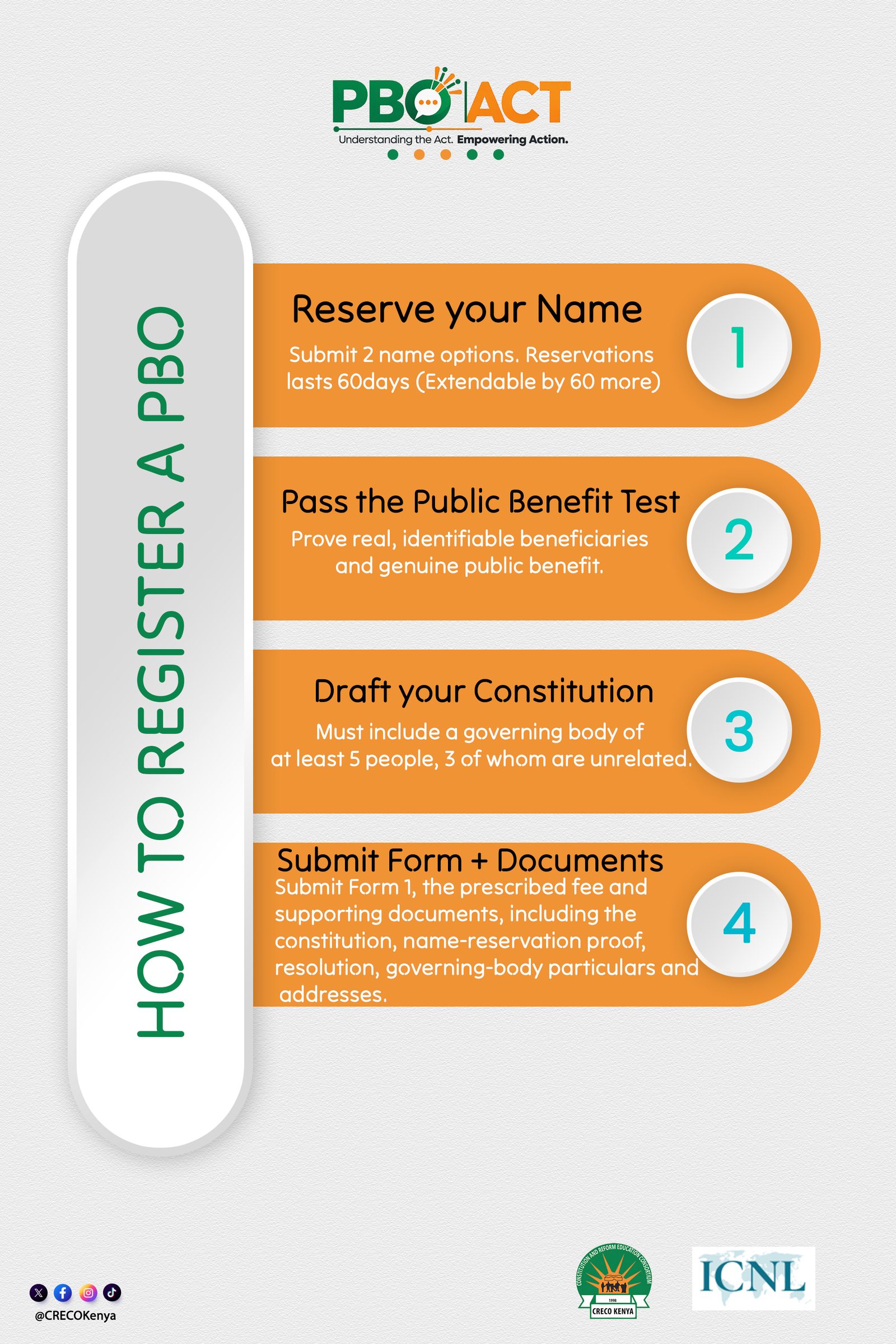
Step One: Reserve the Organization's Name
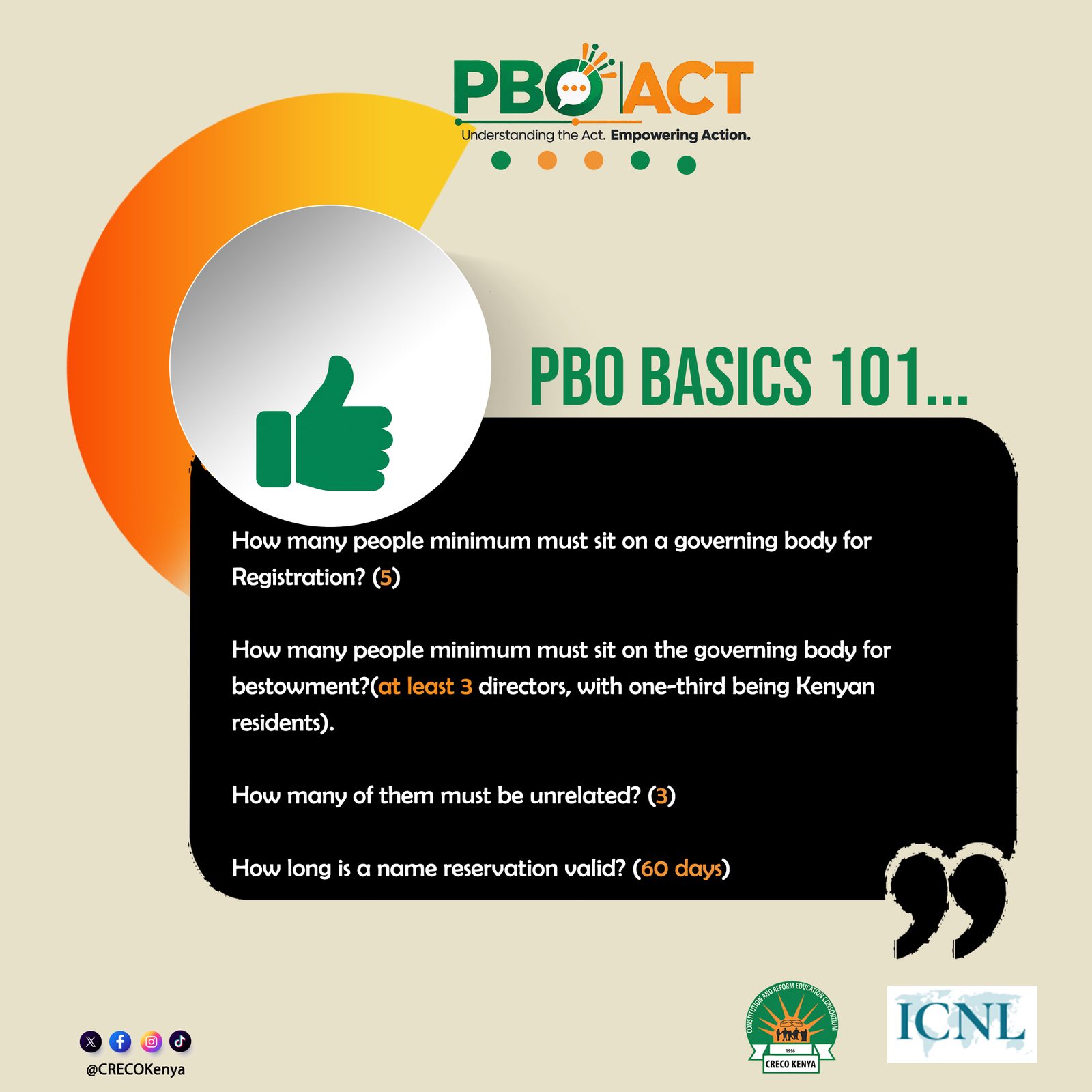
A prospective applicant must first submit a request to the Public Benefits Organizations to conduct a search on the proposed name, including at least two name options and the required fee. If the name is available, the Authority will reserve it for 60 days. If more time is needed, the applicant can request an extension, which can be granted for a further period not exceeding 60 days.
Prohibited Names
The Authority will refuse to reserve or register a name where it:
- is identical or confusingly similar to an existing ;
- would constitute an offence under any law;
- is offensive or undesirable;
- falsely suggests affiliation with a State organ, county government or other public entity.
These restrictions primarily help to protect the public from confusion and prevent organizations from misleading donors, beneficiaries or regulators.
Step Two: Meet the Public Benefit Test
Before , the Authority must be satisfied that the organization's proposed activities genuinely serve the public interest. Regulation 6 introduces five important considerations.
The activities must;
- fall within the public benefit categories listed in the Sixth Schedule to the Act;
- have identifiable beneficiaries (that is, real people or groups who gain from the project)
- directly and not incidentally or unexpectedly advance public benefit as defined under the Act;
- not offer personal or private benefit to directors, officials, their immediate family members or close business associates.
Where an organization undertakes multiple activities, it cannot use one public benefit activity to justify, hide or excuse the lack of public benefit in another activity. Each activity must provide benefit to the public. .
Step Three: Prepare the Organization's Constitution
The constitution is one of the most important documents.
Section 8(4) of the Act prescribes the minimum matters that every constitution must contain. These include:
- the organization's name;
- its objectives;
- a statement that participation or membership (where applicable) is voluntary;
- a non-distribution clause stating that income and assets cannot be shared among members;
- a statement that members or the governing body have no personal rights in the organization’s property;
- organizational and governance structures;
- procedures for meetings and decision-making;
- banking arrangements for financial transactions;
- financial year;
- constitution amendment procedures;
- dissolution procedures; and
- disposal of surplus assets: the transfer of remaining assets upon dissolution to another with similar objectives.
The constitution must also provide for a governing body consisting of at least five persons. At least three of these must not be related. This governance requirement promotes accountability and reduces the risk of organizations being controlled by a single family or small group.
Step Four: Submit the Application
Regulation 8 prescribes the application procedure.
Applications must be submitted using Form 1 contained in the Second Schedule to the Regulations and accompanied by the prescribed fee.
The following documents must accompany the application:
- the organization's constitution prepared in accordance with section 8(4) of the Act;
- proof of reservation of the proposed name;
- minutes of the meeting resolving to seek ;
- particulars of the directors;
- the physical and postal addresses of the organization.
The Act further requires that at least one-third of the directors must be Kenyan citizens residing in Kenya, if the applicant is an international organization that plans to implement activities directly in Kenya; or to operate from Kenya to implement activities in another country; or to fundraise in the country.
Additional Information Required under the Act
Section 8 of the Act also requires applicants to provide:
- names and addresses of the founders;
- the organization's public benefit purposes;
- principal activities;
- principal place of business;
- the prescribed fee; and
- any further information reasonably required by the Authority.
The Regulations give further details regarding the statutory requirements contained in the Act.
Consideration of the Application
Once a complete application has been submitted, the Authority considers whether all legal requirements have been met.
Section 9 of the Act and Rule 8 of the Regulations require the Authority to determine the application within 60 days of receiving it.
Upon satisfaction, the Authority registers the organization and issues a certificate of .
If the Authority identifies deficiencies, it must notify the applicant in writing and give reasons for the decision. It should explain what additional information or corrections are required, and provide a period, not exceeding 30 days from the date of the notice for . The Authority may extend this period once, for up to 21 additional days upon good cause being shown.
If the applicant complies within the specified period, the Authority must register the within 14 days after receiving the requested information.
Refusal to Register
If the applicant does not meet the requirements set out in the notice, the Authority will refuse to register the . The Authority will inform the applicant of this refusal in writing, within the remaining time limit, giving reasons for the decision.
Certificate of Registration
Where the application is approved, the Authority issues a Certificate of . The certificate is issued in Form 2 contained in the Second Schedule of the Regulations.
Section 10 of the Act provides that the certificate constitutes conclusive evidence that the organization is legally registered under the Act.
Legal Effect of Registration
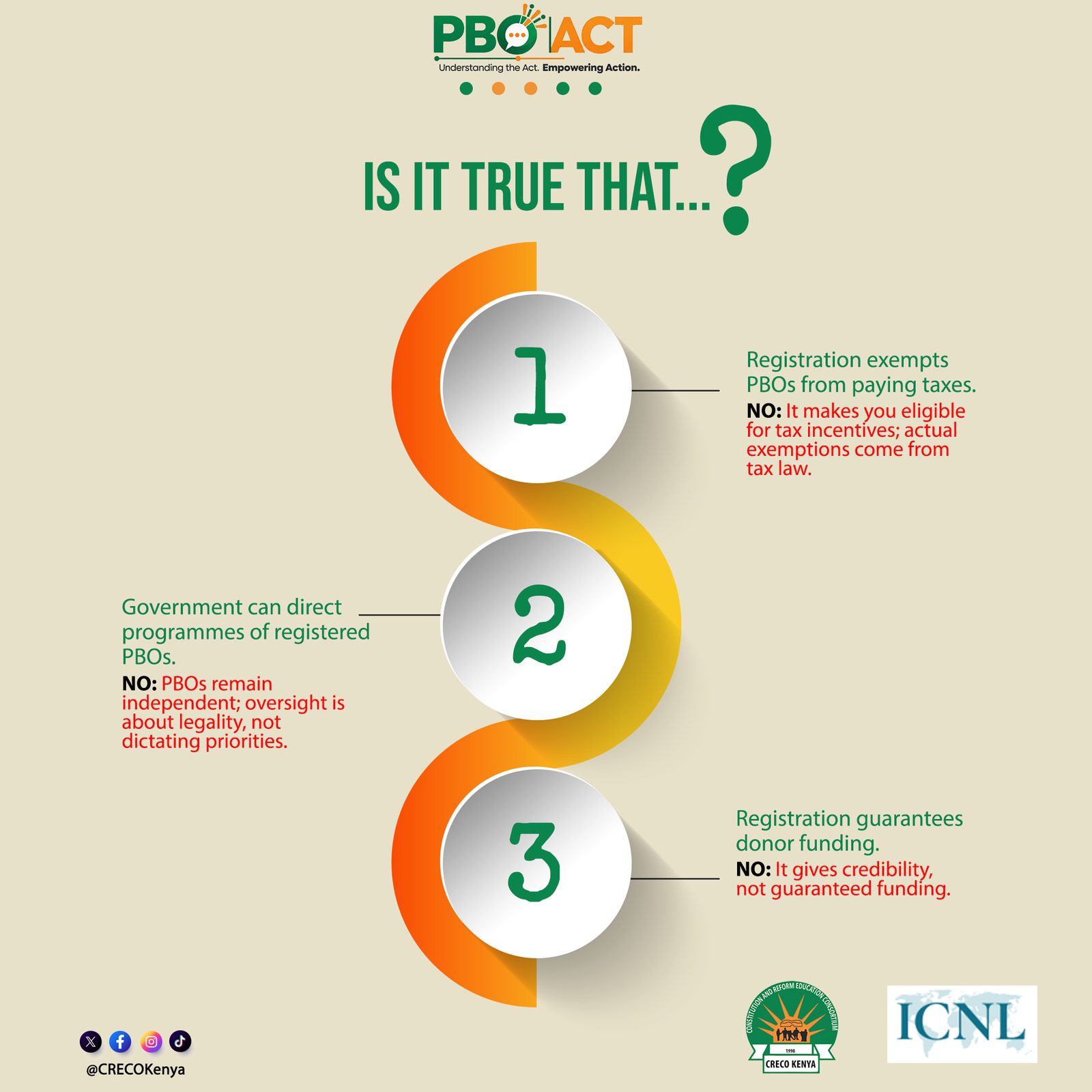
has important legal consequences.
A registered becomes a body corporate with perpetual succession and may:
- sue and be sued;
- own movable and immovable property;
- enter into contracts;
- acquire assets;
- dispose of property;
- perform all lawful acts necessary for achieving its objectives.
therefore gives the organization its own legal identity, separate from its founders or members.
When Does Registration End?
does not expire unless:
- the certificate is cancelled under the Act;
- the organization voluntarily deregisters;
- the organization is dissolved or wound up according to law.
is therefore not subject to periodic renewal under the .
Can the Authority Refuse Registration?
Yes. Where the Authority concludes that the applicant has failed to comply with the requirements in the Act, it may refuse . However, the Act requires procedural fairness. Before refusing , the Authority must:
- notify the applicant in writing;
- explain the reasons for the refusal;
- allow the applicant an opportunity to rectify deficiencies;
- communicate the final decision together with reasons.
An applicant dissatisfied with the decision may seek review or appeal under the mechanisms established by the Act, which are discussed in Summary 7.
Practical Tips for Applicants
Before submitting an application:
- Ensure the proposed name is available and reserved.
- Carefully draft the constitution to comply with section 8.
- Confirm that your activities satisfy the public benefit test.
- Keep accurate minutes authorising .
- Verify that governance structures comply with statutory requirements.
- Prepare complete supporting documentation before filing the application.
- Maintain copies of all documents submitted to the Authority.
Incomplete applications are among the most common causes of delays.
Important Legal Update for Existing NGOs: The transition process for existing NGOs should be distinguished from of new organizations. NGOs that were registered under the repealed NGO Coordination Act are not required to apply for fresh but will transition automatically under the . However, they will need to submit updated information to the Authority to ensure that their records are aligned with the framework. Transition to the should be understood in light of the High Court decision in Otieno & 2 others v Attorney General & another (2025) and Article 36 of the Constitution.
Legal References
Public Benefits Organizations Act, 2013: Sections 6–10 (, Requirements, Consideration of Applications and Certificates of ).
Public Benefits Organizations Regulations, 2026: Regulations 4–8 (Name Reservation, Prohibited Names, Public Benefit Test and Procedure).
This summary is general information, not legal advice. Read it with the Public Benefit Organizations Act, 2013 and the Public Benefit Organizations Regulations, 2026.