
- The Regulations provide the practical procedures that implement the .
- Organizations should use the prescribed forms for all statutory applications and notifications.
- Annual reports must be submitted within six months after the end of the financial year.
- Material changes must be reported promptly using the prescribed procedures.
- It is essential to maintain accurate records and observe statutory timelines forcompliance.
- Effective systems protect both the organization and the wider sector.
- is an ongoing responsibility that extends throughout the lifecycle of every .

Knowledge hub
Practical Guide to Compliance
Listen to this page
Prefer listening? Play to hear this topic read in a clear voice.
At a glance
Read the full explanation
Practical Guide to Compliance
Key Forms, Timelines, Fees and Material Changes under the Public Benefits Organizations Regulations, 2026
Why this Summary Matters
The obligation to comply with the Public Benefits Organizations Act, 2013 does not end once an organization is registered. Public Benefit Organizations have ongoing legal obligations that help ensure transparency, accountability and effective regulation throughout their lifecycle.
The Public Benefits Organizations Regulations, 2026 operationalise the Act by prescribing the forms to be used, the procedures for making applications, the timelines for submitting reports, the fees payable for various services and the notifications that organizations must provide when significant changes occur.
This summary brings together these practical requirements into a single guide that organizations can use as a quick reference. It complements the earlier summaries by focusing on what organizations need to do, when they need to do it, and how they should comply.
Why Compliance Matters
is not simply about avoiding penalties. It helps organizations maintain their legal status, preserve public confidence, strengthen donor credibility, demonstrate accountability, avoid regulatory disputes and access opportunities available to registered PBOs.
Good also supports effective organizational management and long-term sustainability.
Prescribed Forms under the Regulations
The Regulations prescribe standard forms that must be used when dealing with the Public Benefits Organizations . These forms promote consistency, completeness and administrative efficiency.
The key prescribed forms include:
- Form 1: Application for as a or international .
- Form 2: Certificate of as a .
- Form 3: Application for bestowment of status.
- Form 4: Certificate of bestowment of status.
- Form 5: Certificate of as an international .
- Form 6: Application for exemption from as an international .
- Form 7: Permit to operate as an exempt international .
- Forms 8 and 9: Notices relating to intended cancellation, suspension, cancellation or suspension.
- Form 10: Application for restoration or reinstatement.
- Forms 11 and 12: Application and certificate for recognition of a forum or federation of forums.
- Form 13: Annual report.
- Form 14: Notification of material changes.
- Forms 15 and 16: Notification and certificate of change of name.
Organizations should always ensure that they use the latest prescribed forms issued by the Authority.
Important Transition Note: Form 1 is used for fresh applications. It may also be used by organizations transitioning from the NGO framework into the framework, to provide updated information to the Authority for purposes of . This transition process should be distinguished from the of a completely new organization. A recent High Court decision affirmed that NGOs previously registered under the repealed NGO Co-ordination Act will automatically transition into the framework without losing their legal identity.
Important Note on Forums and Federations: Membership of Self-Regulation Forums and Federations under the Regulations is not compulsory. A may choose whether or not to join a forum or federation. Non-membership should not, by itself, affect a ’s status, rights or standing. A recent High Court decision confirmed that compulsory federation membership is inconsistent with the freedom of association. The provisions of the on membership of the National Federation of PBOs should be interpreted in line with this decision.
Supporting Documents
Most applications submitted under the Regulations must be accompanied by supporting documentation. Depending on the application, these documents may include:
- the constitution or other governing instrument;
- certificate of incorporation or ;
- proof of name reservation;
- minutes or resolutions authorising the application or change;
- particulars of directors, officials or governing body members;
- information on physical and postal address;
- proof of good standing where required;
- proof of source of funding for international organizations where required;
- audited accounts where required; and
- other documents specified in the Regulations.
Incomplete applications may delay processing or result in requests for additional information.
Statutory Timelines
The Regulations establish timelines for different obligations. Organizations should pay close attention to deadlines relating to name reservation, applications, annual reporting, notification of material changes, restoration, reinstatement and responses to notices from the Authority.
For example, name reservation is valid for 60 days and may be extended for a further period not exceeding 60 days. , bestowment, international and exemption applications are generally determined within 60 days. Restoration and reinstatement applications must be determined within 14 days. Annual reports are submitted within the timeline set by section 31 of the Act, which is within six months after the end of the financial year.
Meeting statutory deadlines helps organizations avoid unnecessary regulatory action. The following table outlines the key requirements and timelines for various legal processes.
| Procedure | Intended User | Key Requirements | Accompanying Documents | Timeline |
|---|---|---|---|---|
| Annual Returns | Registered PBOs | The audited accounts must be prepared by recognised auditors in good standing with; Institute of Certified Public Accountants of Kenya(ICPAK),; in accordance with the accounting standards specified by the Authority. | Certified copy of financial statements, activity report of the for that financial year | The must submit the Returns within 6 months from the date of completion of their financial year. |
| (National ) | New/existing groups seeking to operate locally | The group must demonstrate actual or intended public benefit activity | Completed application Form 1, Constitution of the , the reserved name of the , minutes approving , the official bearers, and physical and postal address | The Authority shall consider the application within 60 days; name reservation valid for 60 days |
| (International ) | Foreign entities directly implementing programmes/fundraising in Kenya | Directly implements activities/programmes or raises funds in/from Kenya; is a body corporate registered in its country of origin and in good standing; has operated for at least three years; engaged in public benefit activities under the Sixth Schedule | Same core documents as national , plus proof of foreign incorporation; good standing; source of funding. | 60 days (same standard as above) |
| Exemption | Foreign organizations working indirectly (via local partners, grants, technical support) | Does not intend to directly implement any activities in Kenya or intends to operate from Kenya to implement elsewhere — operates via local partners, grants, policy guidance, or technical support | Proof of home-country ; description of indirect activities in Kenya; Completed application Form 6, Constituting document, the reserved name,; Minutes with resolution; proof of source of funding, details of authorised agent | 60 days (same standard as above) |
| Bestowment | Entities already registered under other Kenyan laws (e.g., Trusts, Companies Limited by Guarantee) wanting status without re-registering | Entity is incorporated under other Kenyan laws, in good standing, operating in Kenya, and engaged in public benefit activities under the Sixth Schedule | Completed application Form 3, Constitution, applicant’s certificate, minutes approving bestowment, official bearers, physical and postal address, audited accounts for 3 years | The Authority shall consider the application within 60 days |
| Recognition (Self Regulation; Forum) | A self-regulatory grouping of PBOs | At least 10 PBOs with related objectives | Completed application form 11, Constitutive document,; Proof of name reservation, evidence of geographic reach, meeting minutes, minutes with resolution to join by each member, documents of members, membership lists, office-bearer details, and a code of conduct | The Authority shall consider the application within 60 days |
| Recognition (Self-Regulation; Federation of Forums) | An umbrella body of forums | At least 5 recognized forums | Completed application form 11, Constituting document, reserved name, operation area description, formation meeting minutes, minutes with resolution to join by each forum member, office-bearer details, recognition certificates of constituting forums, and a code of conduct | The Authority shall consider the application within 60 days |
| Re-instatement | A whose was suspended | Organizations have the right to be notified, heard, and to apply for reinstatement after remedying the issue | Uses Form 10 evidence the underlying breach has been corrected | The Authority shall consider the application within 14 days |
| Restoration | A whose was cancelled | may be restored where the cancellation was erroneous or the underlying breach has been remedied | Uses Form 10 evidence of error or remedy | The Authority shall consider the application within 14 days |
Annual Compliance Calendar
It is recommended that every registered should develop an annual calendar. This calendar should track:
- scheduled meetings of the governing body meetings;
- preparation of annual financial statements;
- completion of audits when required;
- submission of the annual report using Form 13;
- review of governance documents;
- review of internal policies;
- updates to records and asset inventories; and
- statutory notifications where changes occur.
A calendar helps ensure that important obligations are duly observed and not overlooked.
Material Changes Requiring Notification
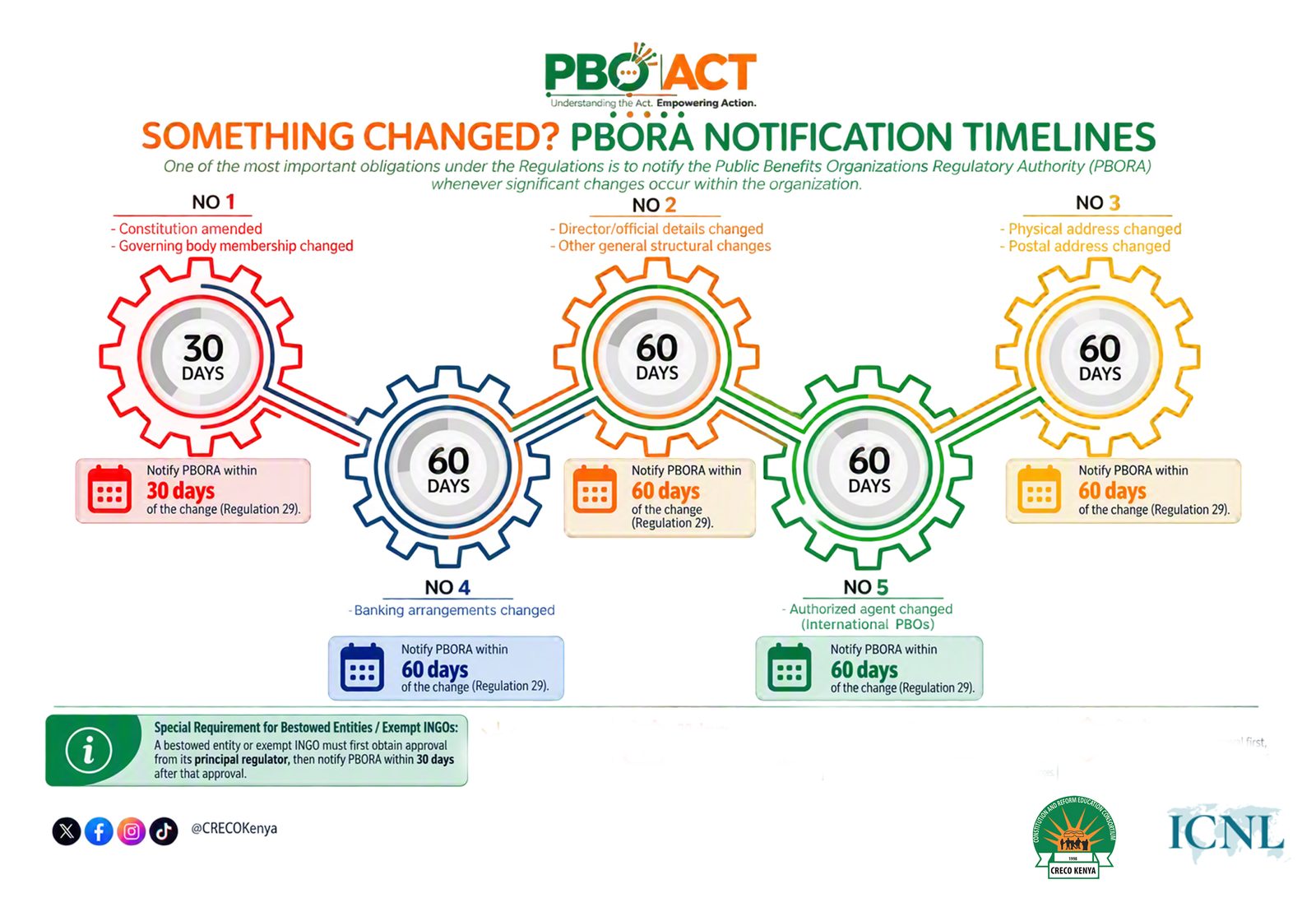
One of the most important obligations under the Regulations is to notify the Authority whenever significant changes occur within the organization.
For PBOs, Regulation 29 identifies the following as material changes requiring notification:
- Changes to the constitution or other constitutive document;
- Changes in the composition of the governing body;
- Changes in the particulars of directors or officials provided during ;
- Changes to the physical or postal address of the principal place of operation;
- Changes to banking arrangements; and
- Changes regarding the authorised agent, in the case of an international .
Depending on the circumstances, other practical changes may also need to be considered carefully because they may affect the information held by the Authority or the organization’s legal status.
Changes to the membership of the governing body must be notified within 30 days. Changes to particulars provided during must be notified within 60 days. Other material changes generally need to be reported within 60 days. Where a material change occurs in an exempt international or an organization conferred with status, the organization must first seek prior approval from its principal regulator and then notify the Authority within 30 days of receiving that approval.
Governance Reminder: When notifying the Authority of changes to the governing body, organizations should continue to comply with the governance requirements contained in the Act and Regulations. A registered should maintain a governing body consisting of at least five persons, with at least three of them not being related to one another. Additionally, the organization should continue to satisfy any applicable nationality and residency requirements prescribed by law.
Change of Name
A change of name is treated separately under Regulation 32. A may change its name by a passing a resolution in accordance with its constitution, by direction of the Authority, or by order of the Court.
Where the organization initiates the change, it must submit a notice of change of name using Form 15. This notice should be accompanied by the required supporting documents, including minutes of the meeting where the resolution was passed, proof of reservation of the proposed name, and the prescribed fee. If the change is approved, the Authority will issue a certificate of change of name using Form 16.
SUMMARY OF REQUIREMENTS: NOTIFICATION OF MATERIAL AND NAME CHANGES
| Material Change Notification (Reg. 30) | Change of Name Notification (Reg. 32) | |
|---|---|---|
| Type of material change | • Constitution/constitutive document; • Composition of the governing body; • Particulars of directors or officials; • Address: Physical or postal or principal place of operation; • Banking arrangements; • Authorized agent (international organizations) | resolves to change its name; or the Authority directs a change (name too similar / erroneously registered); or a Court orders it. |
| How initiated | Board/organization passes a resolution on the change | Board passes a resolution under the 's constitution |
| Form to use | Form 14 | Form 15 |
| Required documents | Minutes of the meeting passing the resolution, signed by office bearers; prescribed fee; supporting evidence of the change e.g. amended constitution or updated director details | Completed Form 15, Minutes of the meeting resolving the name change; copy of name search & reservation (Reg. 4); in case of an exempt IPBO or bestowed organization - approval from principal regulator. |
| Fee | Per First Schedule (varies by change type, e.g. KES 4,000 for officials/banking, KES 20,000 for authorized agent) | KES 15,000 (national ); KES 27,500 (international ) |
| Notification deadline | Within 30 days of change: for changes to governing body membership; Within 60 days of change: for changes to particulars or any other change | Must lodge notice with the Authority promptly on passing the resolution;; In case of an exempt IPBO or bestowed organization– within 30 days of receipt of approval from principal regulator |
| PBORA determination timeline | Within 30 days of receiving the notification | Within 14 days of receiving the application |
| Outcome if approved | Change effected in the Register of Public Benefit Organizations | Certificate of Change of Name issued (Form 17); Authority publishes the change annually in the Gazette |
| Outcome if rejected | Applicant notified in writing with reasons | Applicant notified in writing with reasons |
| Effect | Register updated to reflect change | Takes effect from certificate issue date; doesn't affect existing rights, liabilities, assets, or ongoing legal proceedings (which continue under the new name) |
Fees Payable under the Regulations
The First Schedule to the Regulations prescribes the fees charged for various applications and administrative services.
The fees are subject to review by the Cabinet Secretary. Organizations should confirm the applicable fee before submitting any application, as payment of the prescribed fee is generally required for the completion of processing.
| No. | Description of Fee | Amount (KES) |
|---|---|---|
| 1 | Name search and reservation of a proposed name | 1,000 |
| 2 | Extension of a proposed name reservation | 1,000 |
| 3 | as a | 25,000 |
| 4 | Bestowment of status | 20,000 |
| 5 | as an international | 45,000 |
| 6 | Exemption from as an international | 75,000 |
| 7 | Recognition of a forum of public benefit organizations | 10,000 |
| 8 | Recognition of a federation of forums of public benefit organizations | 20,000 |
| 9 | Filing of annual report | 2,000 |
| 10(i) | Notification of material change — change of officials/addition of board members | 4,000 |
| 10(ii) | Notification of material change — authorized agent | 20,000 |
| 10(iii) | Notification of material change — banking arrangements | 4,000 |
| 10(iv) | Notification of material change — name (national ) | 15,000 |
| 10(v) | Notification of material change — name (international ) | 27,500 |
| 10(vi) | Notification of material change — amendment of constitution | 4,000 |
| 10(vii) | Material changes in a forum or federation of forums | 5,000 |
| 11(a) | Replacement of certificate of or permit | 10,000 |
| 11(b) | Certified copies of documents from the Authority | 4,000 |
| 11(c) | File search | 4,000 |
| 11(d) | Certification of other documents from the Authority | 4,000 |
Maintaining Accurate Records
depends on maintaining complete and accurate organizational records. Every should maintain:
- its constitution or governing instrument;
- certificate or certificate of bestowment;
- governing body records;
- minutes of meetings;
- financial and accounting records;
- bank records;
- asset inventory;
- grant agreements and contracts;
- employment records;
- statutory correspondence; and
- reports submitted to the Authority.
Well-maintained records simplify reporting, audits and regulatory inquiries.
Internal Compliance Systems
The following are recommended good practices that help organizations establish internal procedures for monitoring :
- assigning responsibility for statutory reporting;
- maintaining a calendar;
- conducting periodic governance reviews;
- reviewing reporting deadlines;
- retaining copies of all submissions made to the Authority;
- keeping electronic and physical records securely; and
- briefing board members and staff on their responsibilities.
Organizations with strong internal systems are less likely to experience regulatory difficulties.
Electronic Submission and Communication
Regulation 41 allows organizations to submit documents required under the Regulations electronically. Where the Authority provides electronic filing or communication systems, organizations should maintain active email addresses, regularly monitor official communications, keep login credentials secure, update contact information promptly and retain proof of electronic submissions.
Electronic communication can improve efficiency, but it does not remove the organization’s responsibility to comply with legal requirements.
Consequences of Non-Compliance
Failure to comply with the Regulations may result in requests for additional information, directions from the Authority, delayed processing of applications, inquiries, suspension, cancellation, deregistration or penalties in serious cases.
Most issues can be avoided through timely reporting, accurate record-keeping and prompt communication with the Authority.
Practical Compliance Checklist
Every registered should ensure that it complies with the and Regulations. It can keep track of its through:
- Keeping its constitution and governance documents up to date.
- Holding regular governing body meetings and record minutes.
- Maintaining accurate financial and accounting records.
- Submitting annual reports on time.
- Notifying the Authority promptly of material changes.
- Keeping copies of all correspondence with the Authority.
- Reviewing legal at least once each year.
- Training staff and governing body members on responsibilities.
- Maintaining proper document retention systems.
- Seeking clarification from the Authority whenever legal requirements are uncertain.
Frequently Asked Questions
Do I need to notify the Authority every time a board member changes?
Yes. Changes in the composition of the governing body are material changes and should be reported using the prescribed procedures under Regulation 29.
Can I amend my constitution without informing the Authority?
No. Amendments to a ’s constitution or governing instrument are material changes and should be reported to the Authority in accordance with the Regulations.
What happens if I miss a reporting deadline?
The Authority may require the organization to comply, request additional information or take regulatory action depending on the circumstances. Organizations should communicate with the Authority promptly if they anticipate delays.
Should I keep copies of documents submitted to the Authority?
Yes. Organizations should retain copies of all applications, reports, financial statements and correspondence for future reference and regulatory .
Building a Culture of Compliance
should not be viewed as an administrative burden. Organizations that integrate into their governance systems are better able to attract donor support, strengthen public confidence, reduce legal risks, improve decision-making, demonstrate accountability and sustain long-term public benefit work.
Ultimately, is part of good organizational leadership.
Legal References
Public Benefits Organizations Act, 2013: Sections 8, 25–33, 61–65 and the Second Schedule.
Public Benefits Organizations Regulations, 2026: Regulations 26–30, 31–32, 33–44, the First Schedule and the Second Schedule.
This summary is general information, not legal advice. Read it with the Public Benefit Organizations Act, 2013 and the Public Benefit Organizations Regulations, 2026.