
- Good governance is central for the credibility and sustainability of every .
- Every must have an independent governing body that complies with the Act.
- Organizations are required to maintain accurate accounting records and prepare annual reports and financial statements.
- The Regulations outline the necessary reporting procedures, forms and the notification process for any material changes.
- is an ongoing obligation throughout the life of the organization.
- Strong governance not only protects the organization, but also safeguards its beneficiaries and the wider public.

Knowledge hub
Governance, Reporting and Accountability
Listen to this page
Prefer listening? Play to hear this topic read in a clear voice.
At a glance
Read the full explanation
Governance, Reporting and Accountability
Understanding the Governance and Compliance Obligations of Public Benefit Organizations under the Public Benefits Organizations Act, 2013 and the PBO Regulations, 2026
Why this Summary Matters
Public Benefit Organizations (PBOs) play an important role in advancing public welfare, protecting human rights, delivering services and supporting national development. To maintain public confidence and ensure that resources are used responsibly, the Public Benefits Organizations Act, 2013 establishes clear standards for governance, financial management, reporting and accountability.
Good governance is not just a legal obligation - it is fundamental to an organization's credibility, sustainability and effectiveness. Sound governance systems help organizations make better decisions, manage resources responsibly, comply with donor and legal requirements and build trust among beneficiaries, partners, regulators and the public.
The outlines the core governance and accountability obligations, while the Public Benefits Organizations Regulations, 2026 prescribe the practical procedures for reporting, record-keeping, notifications and .
What is Good Governance?
Governance refers to the systems, structures and processes through which a is directed, managed and held accountable.
Good governance requires an organization to:
- pursue its stated public benefit purposes;
- act in the best interests of the organization and its beneficiaries;
- manage resources responsibly;
- comply with applicable laws;
- maintain transparency in decision-making; and
- remain accountable to its members, donors, beneficiaries, regulators and the public.
The therefore promotes governance as a means of protecting both organizations and the communities they serve.
Governing Body
Every registered must have a governing body responsible for overseeing the affairs of the organization.
Section 8 of the Act requires every organization seeking to establish a governing body consisting of at least five persons, with at least three members who are not related to one another.
This requirement promotes independence in decision-making and accountability and reduces the risk of conflicts of interest or concentration of control within a single family or small group.
The governing body is responsible for ensuring that the organization:
- complies with the law;
- fulfils its public benefit objectives;
- manages resources responsibly; and
- exercises proper oversight over management.
Duties of Office Bearers
The Act in section 8(7) provides an outline of a few key responsibilities that members of the governing body of a must carry out including:
- Reviewing or approving the organization’s financials and programs;
- Selecting members of the governing body;
- Determining the procedure for amending the constitution;
- Making decisions on dissolving the organization.
In line with good practice, the governing body is also expected to act honestly, diligently and in the best interests of the organization.
This includes ensuring that the organization is:
- Using it’s resources only for authorized purposes;
- Making decisions in accordance with the constitution;
- Managing conflicts of interest properly;
- Keeping accurate financial records.
- Submitting statutory reports on time; and
- Complying with applicable laws.
Office bearers should not use their positions for personal gain or benefit themselves, their families or their businesses with organizational resources.
Governing Documents
Every must operate in accordance with its constitution or governing instrument.
The constitution should reflect the requirements prescribed under Section 8 of the Act, including:
- the organization's objectives;
- governance structure;
- membership provisions where applicable;
- financial management arrangements;
- decision-making procedures;
- constitution amendment procedures;
- dissolution procedures; and
- the transfer of assets upon dissolution to organizations with similar public benefit purposes.
Any amendments affecting these provisions should be communicated to the Authority in accordance with the Regulations governing material changes.
Financial Management
Sound financial management is one of the central accountability obligations for each under the Act.
Every should maintain systems that ensure:
- accurate financial records;
- proper approval for spending;
- careful management of assets;
- separation of financial duties where possible;
- proper banking arrangements;
- supporting documentation for all transactions; and
- responsible management of donor and organizational resources.
Good financial management protects the organization against fraud, mismanagement and misuse of funds while strengthening donor confidence.
Accounting Records
Section 30 of the Act requires Public Benefit Organizations to keep accurate books of account and other records relating to their operations and activities. PBOs also need to prepare annual statements of account in accordance with applicable accounting standards for non-profit organizations.
Records should generally include:
- cash books;
- bank records;
- receipts;
- payment vouchers;
- payroll records;
- asset registers;
- grant agreements;
- procurement records;
- contracts; and
- supporting documentation for financial transactions.
Maintaining complete records facilitates both internal management and accountability to external parties.
Annual Reports
The Act requires registered Public Benefit Organizations to submit annual reports to the Public Benefits Organizations .
These reports enable the Authority to ensure that organizations comply with the Act while providing information on their governance, activities and financial management.
Although reporting formats are prescribed by the Regulations, annual reports generally include information on:
- activities undertaken during the year;
- achievement of objectives;
- governance arrangements;
- financial performance;
- sources of funding; and
- any significant developments affecting the organization.
Timely reporting is one of the most important ongoing obligations of every registered .
Financial Statements
Organizations are required to prepare annual financial statements, in addition to narrative reports.
Financial statements should include:
- a certified copy of financial statements;
audited statement of accounts Financial statements should present a true and fair view of the organization's financial affairs.
Audit Requirements
The Act empowers the Authority to require audited accounts from all PBOs.
Many organizations are also required by:
- their constitutions;
- donor agreements;
- funding contracts; or
- other applicable laws
to have their financial statements independently audited.
Regular audits strengthen accountability, identify weaknesses in internal controls and enhance public confidence.
Annual Reports submission
The Regulations outline the reporting obligations established under the Act by prescribing:
- the forms to be used;
- submission procedures;
- reporting timelines;
- electronic filing requirements where applicable; and
- supporting documentation that must accompany annual reports and statutory filings.
Organizations should ensure that they use the current prescribed forms and comply with the reporting deadlines established by the Regulations.
Notification of Material Changes
One of the most significant obligations under the Act is the duty to notify the Authority whenever certain significant changes occur within the organization.
Material changes generally include changes relating to:
- the organization's name;
- principal place of operation ;
- postal or physical address;
- composition of the governing body
- particulars of directors or office bearers submitted during ;
- constitution;
- public benefit objectives;
- bank arrangements; and
- authorized agent, in the case of IPBOs.
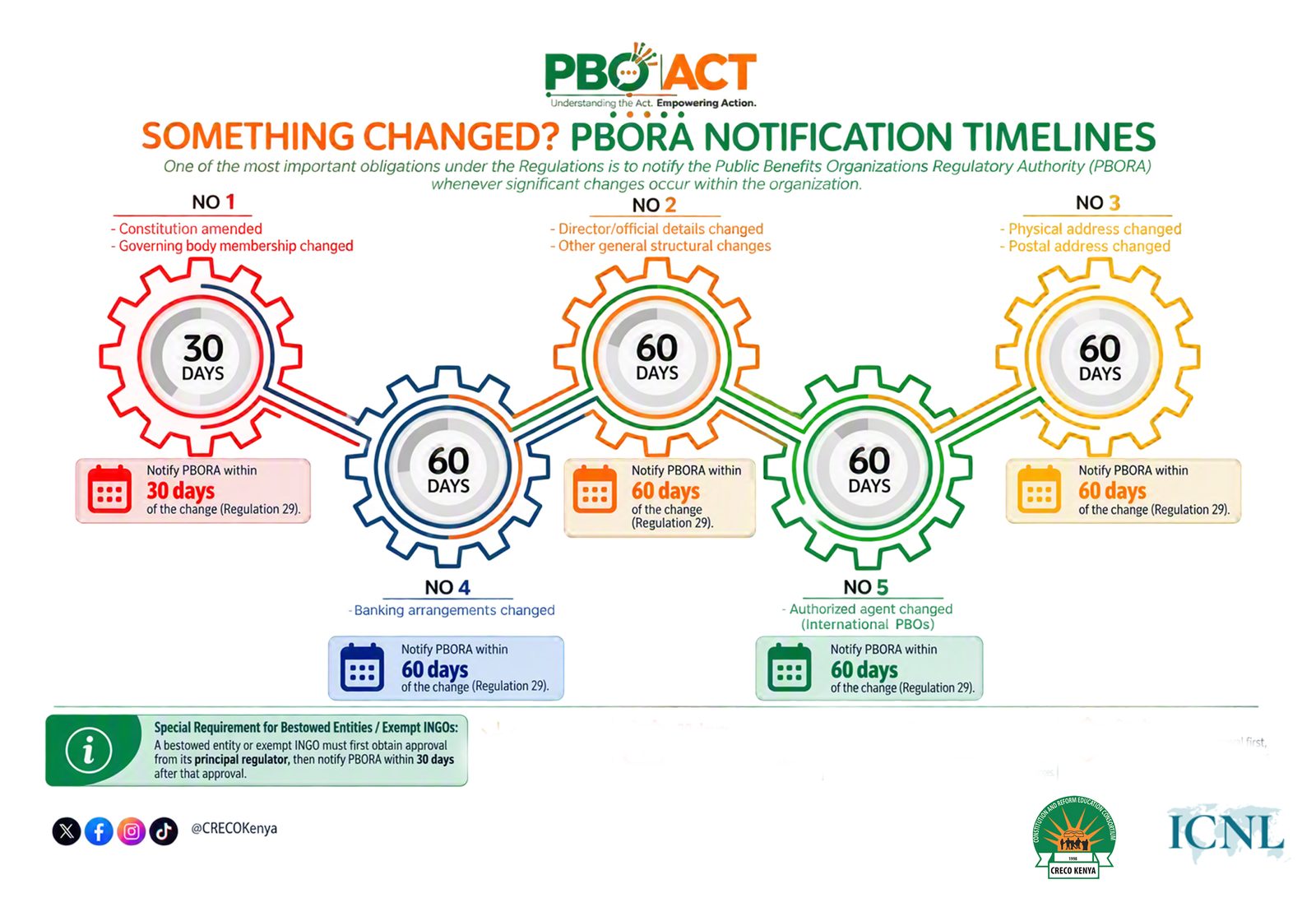
Notification helps the Authority to maintain accurate records and supports effective regulatory oversight. It should be carried out within the timelines provided in the Regulations, rule 29:
- In the case of a change in the membership of the governing body of a , within thirty days of the change;
- In the case of a change in the particulars provided during , within sixty days of the change; and
- In the case of any other change, within sixty days of the change.
Record Keeping
The Regulations require organizations to retain up to date organizational records, including the following:
- Its audited accounts
- Its annual financial statements
- A detailed inventory of the organization’s assets
- An annual report of its activities and programs.
Good record management enables organizations to:
- demonstrate ;
- prepare reports efficiently;
- respond to donor requirements;
- facilitate audits;
- support organizational continuity; and
- resolve disputes where necessary.
Transparency and Accountability
In pursuit of their objectives, PBOs should be guided by the principles outlined in section 25 (2) and 27 of the Act. This includes fostering a culture of transparency and accountability in all operations, particularly concerning the receipt and management of resources. Further, the governing body should create clear guidelines for the conduct and operations of the organization, including measures to prevent conflict of interest.
Transparency involves making accurate information available to those who have a legitimate interest in the organization's work.
Accountability requires organizations to explain how resources have been used and whether their activities have achieved their stated objectives.
Practical measures include:
- holding regular governing body meetings;
- documenting decisions through minutes;
- preparing annual work plans;
- maintaining financial controls;
- responding honestly to regulatory inquiries;
- communicating appropriately with donors and beneficiaries.
- establishing document retention policies to ensure that important records remain accessible and secure.
Good governance is ultimately about earning and maintaining public trust.
Compliance with Lawful Directions
The Authority may issue lawful directions within the powers granted under the Act.
Public Benefit Organizations are expected to cooperate with the Authority and comply with lawful requests relating to:
- reporting;
- inquiries;
- clarification of records;
- monitoring; and
- implementation of statutory requirements.
Cooperation with regulatory oversight contributes to a healthy and credible nonprofit sector.
Consequences of Non-Compliance
Failure to comply with governance and reporting obligations may expose an organization to regulatory action.
Depending on the nature and seriousness of the non-, the Authority may:
- require corrective action;
- issue directions;
- conduct inquiries;
- suspend in accordance with the Act; or
- cancel in serious cases.
The Act nevertheless requires that these powers be exercised fairly and in accordance with due process.
The procedures for suspension, cancellation and appeals are discussed in Summary 7.
Common Misconceptions: Is it true that...
"Only large organizations need proper governance systems?"
Incorrect. Every registered , regardless of size, is expected to comply with the governance requirements established under the Act.
"Reporting is only for donors?"
No. Reporting is a statutory obligation owed both to the Authority and, where applicable, to donors, members and other stakeholders.
"Once an organization is registered, there are no further compliance obligations?"
Incorrect. marks the beginning—not the end—of an organization's legal obligations under the Act.
"Only financial matters must be reported?"
No. Organizations must also notify the Authority of prescribed material changes affecting governance, leadership or other key organizational information.
Practical Compliance Checklist
To ensure , every should:
- Hold regular meetings of its governing body and keep accurate minutes.
- Maintain accurate accounting records.
- Prepare annual reports and financial statements.
- Submit annual reports and statutory filings on time.
- Notify the Authority promptly of material changes.
- Keep an up-to-date constitution and governance records.
- Establish effective internal financial controls.
- Cooperate with lawful regulatory oversight.
Retain organizational records in an orderly and secure manner.
Legal References
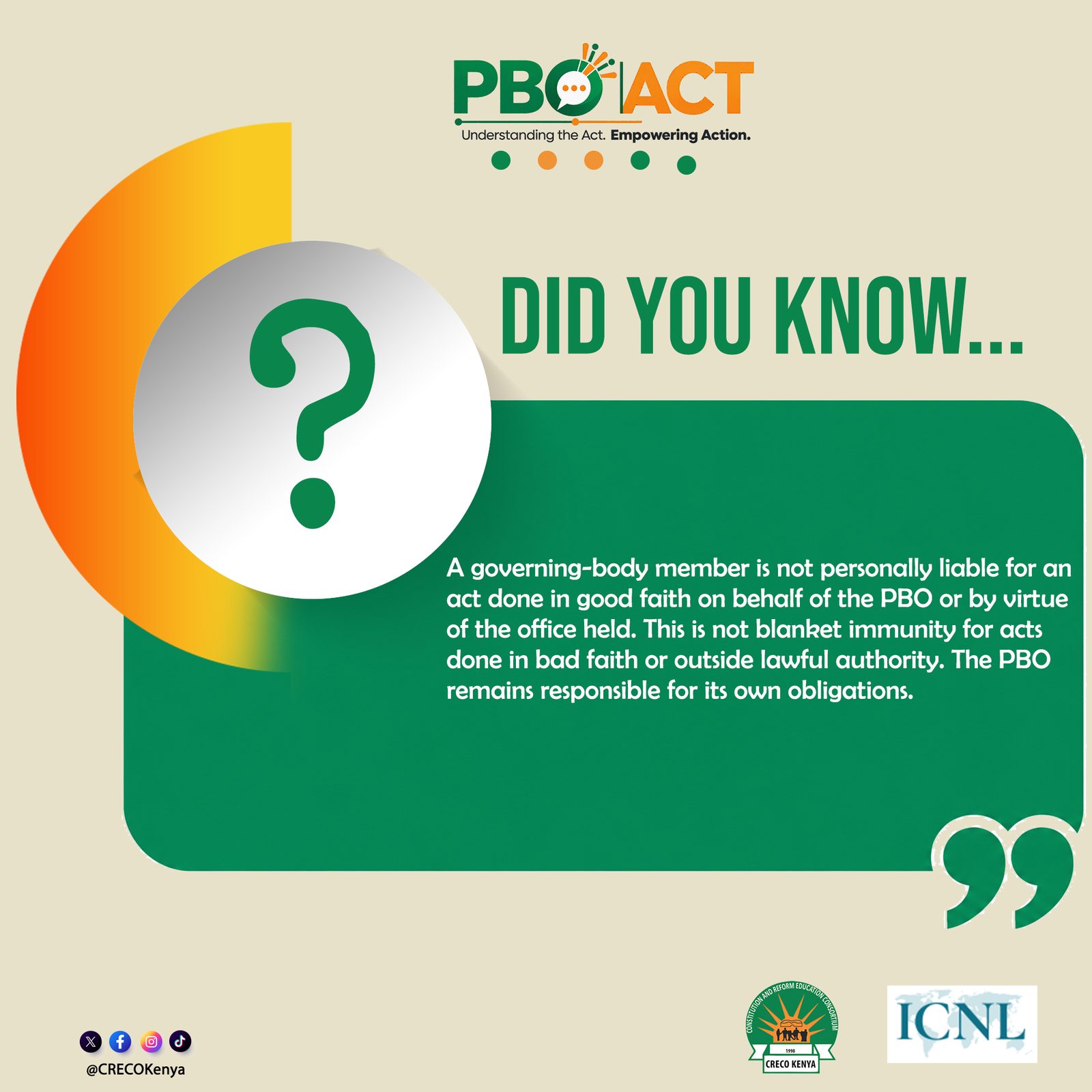
Public Benefits Organizations Act, 2013: Sections 8 (Governance Requirements), 25–33 (Organizational Integrity, Voluntary Service, Ethical Principles, Fiscal Transparency, Accounts, Annual Reports, Duty to Provide Information and Protection from Personal Liability).
Public Benefits Organizations Regulations, 2026: Regulations 26–30 (Records, Annual Reports, Other Inquiries, Material Changes in PBOs, and Material Changes in Forums and Federations), including Forms 13 and 14 in the Second Schedule.
This summary is general information, not legal advice. Read it with the Public Benefit Organizations Act, 2013 and the Public Benefit Organizations Regulations, 2026.