
- International public benefit organizations are organizations incorporated outside Kenya that undertake public benefit activities within Kenya.
- They must generally register under the before commencing operations.
- under the does not replace with immigration, employment, taxation or other applicable laws.
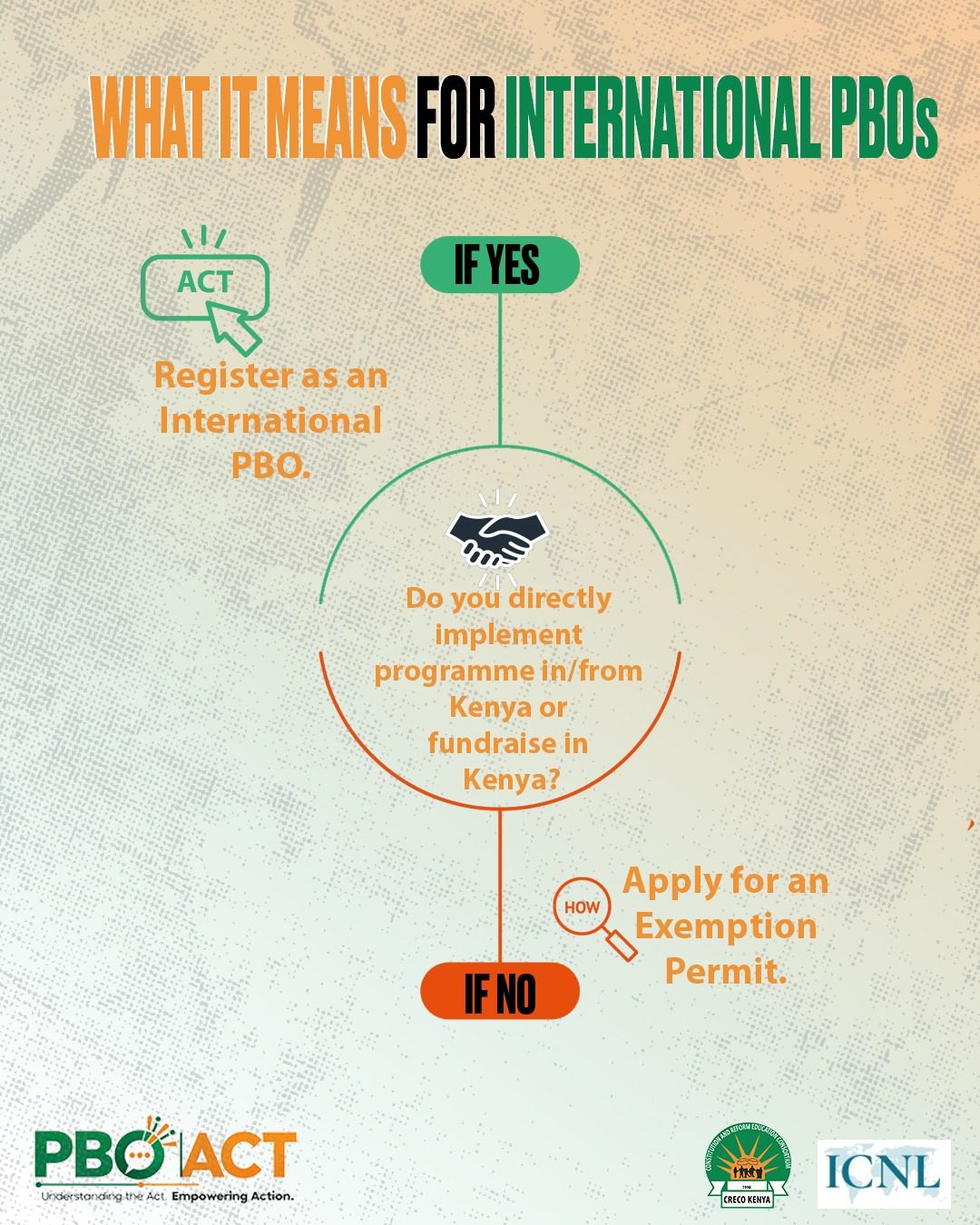
- International organizations that do not directly implement activities in or from Kenya, and instead provide indirect support such as grants, policy guidance or technical assistance, may qualify for a permit for operation as an exempt international .
- Exemption from does not mean exemption from accountability or with Kenyan law.
Knowledge hub
International Public Benefit Organizations and Exempt Organizations
Listen to this page
Prefer listening? Play to hear this topic read in a clear voice.
At a glance
Read the full explanation
International Public Benefit Organizations and Exempt Organizations
Understanding the Legal Framework for International PBOs and Exempt Organizations under the Public Benefits Organizations Act, 2013 and the PBO Regulations, 2026
Why this Summary Matters
Civil society organisations in Kenya include a broad range of organizations, established both locally and abroad that undertake public benefit activities within the country. Many international organizations provide humanitarian aid, support health, education, environmental conservation, governance, human rights and development programmes on their own or in partnership with Kenyan institutions.
The Public Benefits Organizations Act, 2013 recognizes the important role played by international organizations in various areas of public benefit to the country, while ensuring that they operate transparently and are accountable to the law. The Act therefore establishes a legal framework for the and regulation of international public benefit organizations (IPBOs).
The Act also recognises two categories of international organizations:
- Those that directly implement activities in Kenya, raise membership subscriptions, and engage in fundraising, must apply for .
- Those that do not wish to directly implement activities in Kenya and do not raise funds in Kenya, may be exempt from and receive a permit to operate as an exempt international .
The Public Benefits Organizations Regulations, 2026 provide the procedures, documentation, permits and reporting requirements applicable to both categories.
What is an International Public Benefit Organization?
An International is an organization that is incorporated outside Kenya and carries out public benefit activities within Kenya.
Before operating in Kenya, an IPBO must comply with the requirements established under the . under the Act does not create the organization. Rather, it confirms that the organization has met the requirements, is incorporated outside Kenya, and is authorised to lawfully undertake public benefit activities in Kenya.
Why is it important for International Organizations to Register?
The requirement serves several important purposes:
- It enables the Government to maintain an accurate register of organizations operating within Kenya.
- It promotes transparency and accountability regarding the organizations' objectives, governance, funding and activities. It protects beneficiaries and the public by ensuring that international organizations comply with Kenyan law while carrying out their work.
- Finally, it creates a clear legal relationship between the Authority and public benefit organizations operating within Kenya.
therefore supports accountability without preventing legitimate international cooperation.
Eligibility for Registration
Section 11 of the Act provides that an organization incorporated outside Kenya and which intends to directly implement public benefit activities within Kenya may apply to be registered as an International .
The Authority must be satisfied that the applicant:
- is legally established as a non-profit organization outside Kenya;
- pursues public benefit purposes recognised under the Act;
- complies with the requirements of the Act and the Regulations; and
- provides the prescribed documentation.
The public benefit test under Regulation 6 applies equally to national and international PBOs. Accordingly, the Authority must be satisfied that the organization's activities genuinely benefit the public and are not established primarily for private gain.
Application for Registration
The Regulations prescribe the application procedure for international public benefit organizations.
Applications must be submitted using the prescribed form contained in the Second Schedule and accompanied by the prescribed fee.
The applicant is generally required to provide:
- evidence of legal incorporation in its country of origin;
- proof that it is in good standing with the registering body;
- its constitution or governing instrument;
- its physical and postal addresses;
- particulars of the directors, one third of whom must be Kenyan nationals residing in Kenya;
- proof of reservation of its proposed name:
- information on its proposed activities in Kenya;
- minutes of the meeting containing the resolution to apply for ;
- proof of source of funding; and
- any other information reasonably required by the Authority.
These requirements allow the Authority to verify both the legal existence of the organization and its proposed operations in Kenya.
Requirement to Have a Physical Presence in Kenya
The Regulations require an International that intends to directly implement activities in Kenya to establish a physical address within the country and provide the Authority with its contact details. It must also appoint an authorised agent, who is a legal representative and a Kenyan citizen, authorised to receive official summons on behalf of the organization.
This facilitates communication with the Authority, enables regulatory oversight, and ensures that beneficiaries, partners and government institutions have an identifiable point of contact.
Where there are changes to the office address or authorised agents’ details, the organization must notify the Authority in accordance with the Regulations governing material changes.
Registration and Certificate
Where the Authority is satisfied that the applicant complies with the Act and the Regulations, it registers the organization as an International and issues the prescribed certificate.
The certificate authorises the organization to operate within Kenya in accordance with the Act.
Work Permits and Immigration Compliance
under the is distinct from immigration approval.
Foreign nationals working for an International must comply with Kenya's immigration laws, including obtaining any required work permits or entry permits.
Similarly, under the does not automatically authorise foreign personnel to reside or work in Kenya.
Organizations should therefore ensure with both the legal framework and immigration requirements.
Reporting Obligations
Once registered, an International is subject to many of the same accountability obligations as locally registered Public Benefit Organizations.
These include obligations to:
- maintain proper governance structures;
- keep accurate financial records;
- submit annual reports and financial statements where required;
- notify the Authority of material changes;
- comply with lawful directions issued under the Act; and
- continue operating exclusively for public benefit purposes.
Failure to comply may result in regulatory action under the Act, including suspension or cancellation of .
Eligibility for Exemption from Registration
Under section 11 of the Act and Regulations 13 and 14, an organization incorporated outside Kenya may qualify for a permit to operate as an exempt international , if it does not intend to directly implement activities or programmes in Kenya, or to operate from Kenya to implement activities or programmes in another country.
Organizations providing grants, technical assistance, policy support, collaborating with local partners to achieve their objectives or similar indirect public benefit support may qualify for exemption, subject to the Act and Regulations.
An exempt organization must apply for and obtain a permit from the Authority using the prescribed form, and must provide documents such as its constituting document, certificate of from its country of origin, proof of name reservation, board minutes, particulars of directors, proof of funding source, and particulars of its authorised agent.
The permit may be cancelled if the organization directly implements activities or programmes in Kenya, undertakes activities that are not public benefit activities, engages directly with beneficiaries, or fails to comply with the Act or the Regulations.
Recognition of Exempt International Public Benefit Organizations
Although international organizations that engage in indirect implementation are not required to register as Public Benefit Organizations, the Regulations require them to apply for permits of operation from the Authority in the manner prescribed.
This enables the Authority to maintain appropriate records of organizations operating within Kenya while respecting the legal arrangements under which those organizations were established.
Responsibilities of Exempt Organizations
Being exempt from does not mean being exempt from accountability.
Exempt organizations are still expected to:
- operate within the scope of their recognised legal mandate;
- comply with applicable Kenyan laws;
- cooperate with relevant public authorities where required;
- observe any reporting obligations imposed under their governing agreements or applicable legislation.
The Authority may also require information necessary for regulatory or administrative purposes, consistent with the Act and any applicable agreements.
Can an International PBO Have Kenyan Partners?
Yes.
The Act encourages collaboration between international organizations and Kenyan Public Benefit Organizations.
Many international organizations implement programmes through partnerships with local PBOs, community organisations, government institutions and county governments.
Ideally, in line with good practice, such partnerships should be governed by written agreements that clearly define responsibilities, accountability arrangements and obligations.
Common Misconceptions: Is it true that...
"Registration under the PBO Act automatically gives an international organization diplomatic status?"
No. Diplomatic status is granted under international law or diplomatic agreements, not under the .
"International organizations do not have to comply with Kenyan law?"
Incorrect. Unless specifically exempt under another legal instrument, international PBOs operating in Kenya are subject to the and other applicable Kenyan laws.
"An exempt organization is exempt from all regulation?"
No. The exemption relates only to under the . Exempt organizations remain subject to the legal instruments under which they operate and other applicable laws.
Practical Tips
Before commencing operations in Kenya, an international organization should:
- confirm whether it requires or qualifies for an exemption;
- prepare incorporation documents from its country of origin;
- establish a physical office or appoint an authorised representative in Kenya where required;
- ensure with immigration and employment laws;
- maintain proper financial and governance records;
- establish internal systems for reporting and notification of material changes.
Legal References
Public Benefits Organizations Act, 2013: Sections 11–12 (international public benefit organizations and Exempt Organizations).
Public Benefits Organizations Regulations, 2026: Regulations 11–15 (International , Exemption from , Permit Applications and Obligations after ), including Forms 1, 5, 6 and 7 in the Second Schedule.
This summary is general information, not legal advice. Read it with the Public Benefit Organizations Act, 2013 and the Public Benefit Organizations Regulations, 2026.