
- The is both a regulatory and an enabling law.
- gives a its own legal personality and corporate status.
- Registered PBOs may own property, enter contracts and institute legal proceedings.
- Since PBOs are recognized as separate legal entities, their directors and officials cannot be held personally liable for actions taken in good faith on behalf of the organization.
- PBOs enjoy institutional independence while remaining accountable under the law.
- The Act provides eligibility for tax and other fiscal incentives, but this does not guarantee automatic entitlement.
- Rights under the Act are accompanied by corresponding responsibilities related to governance, reporting and accountability.

Knowledge hub
Rights and Benefits of Registered Public Benefit Organizations
Listen to this page
Prefer listening? Play to hear this topic read in a clear voice.
At a glance
Read the full explanation
Rights and Benefits of Registered Public Benefit Organizations
Understanding the Rights, Privileges and Legal Protections of Public Benefit Organizations under the Public Benefits Organizations Act, 2013
Why this Summary Matters
The Public Benefits Organizations Act, 2013 is not merely a regulatory law. It is also an enabling law that recognises the important contribution of Public Benefit Organizations (PBOs) to Kenya's social, economic and democratic development. In addition to setting standards for accountability and good governance, the Act provides registered PBOs with a range of rights, protections and benefits intended to create an environment in which they can operate effectively and independently.
These rights reflect Articles 36, 37 and 33 of the Constitution of Kenya, which guarantee the freedoms of association, assembly and expression respectively. The Act therefore seeks to balance regulatory oversight with the constitutional protection to support civic participation and public benefit work.
This chapter primarily contains references from the Public Benefits Organizations Act, 2013.
An Enabling Legal Framework
One of the defining features of the is its recognition that Public Benefit Organizations are partners in national development rather than entities requiring control.
Section 3 identifies one of the principal objectives of the Act as creating an enabling environment for the establishment, growth and operation of Public Benefit Organizations. The Act also seeks to encourage transparency, accountability and cooperation between the Government and the sector while safeguarding constitutional freedoms.
This philosophy informs all the rights and benefits provided under the Act.
Right to Exist and Operate as a Legal Entity
Perhaps the most important benefit of is that a registered acquires legal personality.
Section 10 provides that upon , a becomes a body corporate with perpetual succession and a common seal. It is capable of:
- suing and being sued in its own name;
- entering into contracts;
- acquiring, holding and disposing of movable and immovable property;
- borrowing or lending where permitted by law;
- carrying out lawful acts necessary to achieve its objectives.
This means that the organization exists independently of its founders, directors or members. Changes in leadership do not affect its legal existence.
Since PBOs are legal entities in their own right, the Act in section 33 expressly protects directors and governing-body officials. They cannot be held personally liable for anything done in good faith on behalf of the organization, or simply by virtue of holding office. In practice, this means the PBO itself, not the individual directors, bears legal responsibility for its actions, so long as those actions were taken honestly and within the scope of its role.
Right to Own Property
A registered may acquire, own, lease, manage and dispose of property in its own name.
This is particularly important because it allows organizations to:
- own offices and land;
- acquire vehicles and equipment;
- receive donations of property;
- enter into lease agreements;
- hold intellectual property; and
- manage assets independently of individual office bearers.
Ownership by the organization protects both the institution and its members by ensuring that organizational assets are not treated as personal property.
Right to Enter Contracts
A registered may enter legally binding agreements with:
- donors;
- government institutions;
- county governments;
- development partners;
- suppliers;
- consultants;
- employees;
- service providers; and
- other organizations.
Because the organization has legal personality, contracts are entered into by the itself rather than by individual members.
This strengthens institutional continuity and accountability.
Right to Institute or Defend Legal Proceedings
A registered can take legal action in court or defend itself in legal matters.
For example, a may:
- enforce its rights in contracts;
- challenge illegal administrative decisions;
- protect its property;
- seek a review of judicial decisions where appropriate;
- defend claims made against it.
This ability to act legally is essential for protecting the organization's interests and ensuring that it can access justice.
Right to Carry Out Public Benefit Activities
authorises a to pursue the public benefit purposes contained in its constitution and approved by the Authority.
These activities may include but are not limited to any of the areas listed under the Sixth Schedule of the such as:
- civic education;
- humanitarian assistance;
- environmental conservation;
- governance programmes;
- health services;
- education;
- legal aid;
- research;
- human rights advocacy;
- peacebuilding;
- youth empowerment;
- disability inclusion;
- women's rights; and
- consumer protection.
A must, however, continue to operate within its approved objectives and applicable laws.
Right to operate as an Independent entitys
Although PBOs are registered and regulated by the Authority, they operate as independent entities..
The Act recognises that Public Benefit Organizations are autonomous institutions capable of determining their own programmes, priorities and internal governance, provided these remain consistent with the law.
Government oversight therefore primarily addresses legality, accountability and transparency rather than directing an organization's programmes or policies.
This principle reflects the constitutional guarantee of freedom of association.
Right to Fair Administrative Action
Like all persons and institutions in Kenya, Public Benefit Organizations are entitled to fair administrative action as outlined in Article 47 of the Constitution.
The Act reinforces this principle by requiring the Authority to act fairly when exercising its powers.
For example, where the Authority decides refuse, suspend or cancel an organisation’s , it must:
- provide written notice;
- explain the reasons for the proposed action;
- allow the organization an opportunity to respond; and
- communicate its final decision.
These procedural safeguards help ensure that regulatory powers are exercised in a lawful and transparent manner.
Right to Review of Administrative Decisions
A registered that is dissatisfied with certain decisions of the Authority may appeal to the Public Benefits Organizations Disputes Tribunal established under the Act.
This provides an independent mechanism for reviewing regulatory decisions without limiting PBOs to the general courts system.
The Tribunal is discussed in greater detail in Summary 9.
Right to Self-Regulation
The Act recognises that effective regulation is not achieved solely through government oversight.
Accordingly, it encourages Public Benefit Organizations to establish self-regulation forums and federations capable of promoting:
- ethical standards;
- accountability;
- peer learning;
- good governance;
- professional conduct;
- dispute resolution within the sector.
This reflects international best practice by recognising the role of civil society in promoting, and maintaining its own standards.
The legal framework governing self-regulation is discussed in Summary 8.
Eligibility for Fiscal and Other Incentives
One of the most significant benefits recognised by the Act is eligibility for various incentives intended to support public benefit work.
The Second Schedule to the Act lists benefits of that may be available to registered Public Benefit Organizations, subject to their provision in the applicable tax, procurement, public finance and sector-specific laws. These include:
- tax exemptions and incentives available under relevant tax laws;
- exemptions from duties and fees prescribed by law;
- preferential treatment where authorised under legislation;
- other fiscal or non-fiscal incentives approved by Government.
It is important to note that as a does not automatically exempt an organization from taxation.
Rather, it establishes eligibility for incentives, while the actual grant of tax exemptions is governed by the relevant legislation, including the Income Tax Act, the Value Added Tax Act, the Excise Duty Act and related tax laws administered by the Kenya Revenue Authority (KRA).
Right to Seek, Receive and Use Donations and Grants
As part of its right to associate, a registered may lawfully receive:
- grants;
- donations;
- gifts;
- endowments;
- contributions;
- membership subscriptions;
- service income;
- investment income; and
- other lawful sources of funding.
Income Earning Activities: A can carry out lawful economic activities as long as the income supports the public benefit purposes for which it was created.
The organization must, however, account for these resources in with the Act, Regulations and applicable financial management standards.
Maintaining transparency in the management of resources is a core principle of the legal framework.
Protection from Arbitrary Interference
The Act seeks to protect Public Benefit Organizations from arbitrary or unlawful interference.
Regulatory decisions must be exercised:
- within the powers granted by the Act;
- fairly;
- reasonably;
- transparently; and
- consistently with the Constitution.
Where an organization believes that these standards have not been observed, it has a right to seek a review through the Tribunal or the courts.
Responsibilities Accompanying These Rights
The rights provided under the Act are accompanied by corresponding responsibilities.
To continue enjoying these protections, every registered must:
- maintain good governance;
- operate exclusively for public benefit purposes;
- submit reports required by law;
- maintain proper financial records;
- comply with lawful directions of the Authority;
- notify the Authority of material changes; and
- uphold transparency and accountability.
Failure to fulfil these obligations may result in sanctions and in some cases, suspension or cancellation of , as discussed in Summary 7.
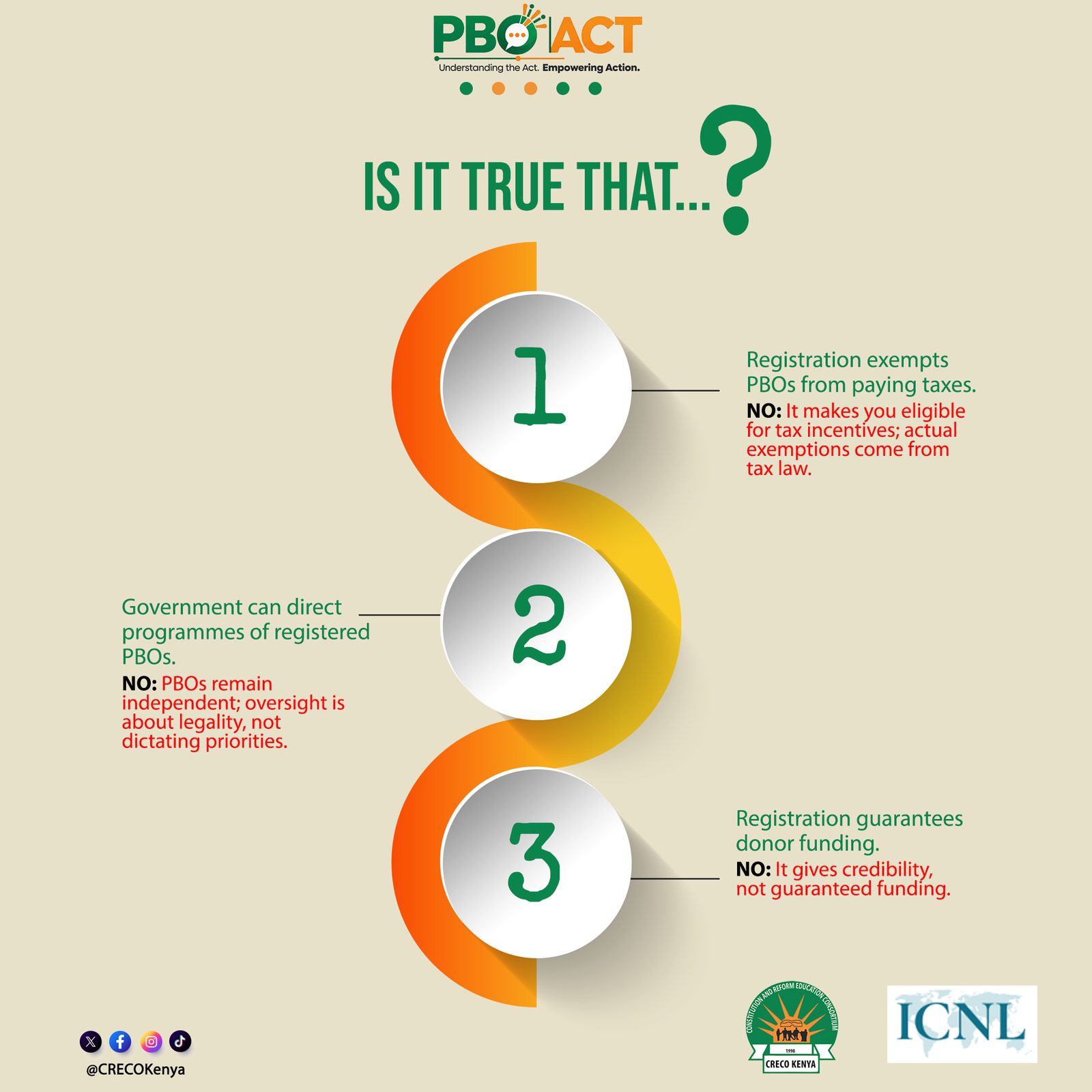
Common Misconceptions: Is it true that...
"Registration automatically exempts a PBO from paying taxes."
No. makes an organization eligible to apply for tax incentives where provided under tax legislation, but tax exemptions are granted under separate tax laws.
"Government can direct the programmes of registered PBOs."
No. Registered PBOs remain independent entities that are responsible for setting their own priorities, provided they comply with the law.
"Registration guarantees donor funding."
No. provides legal recognition and credibility but does not guarantee funding from donors.
"A PBO can undertake any activity once registered."
No. A must continue to carry out the approved public benefit purposes in its certificate of and ensure that it complies with all applicable laws.
Practical Tips
To maximise the benefits of :
- Keep your records current.
- Maintain sound governance and financial management systems.
- Apply separately for any tax exemptions or fiscal incentives available under tax laws.
- Develop policies that promote transparency and accountability.
- Keep accurate records of grants, donations and expenditures.
- Ensure that all activities remain consistent with your constitution and approved public benefit purposes.
Legal References
Public Benefits Organizations Act, 2013: Sections 3–4 (Objects and Government Responsibility); Section 10 (Corporate Status); Section 65 (Income and Economic Activity); Section 66 (Public Policy and Political Activities); and the Second Schedule (Benefits of ).
Public Benefits Organizations Regulations, 2026: The Regulations primarily operationalise the Act and contain limited provisions relating specifically to rights and benefits. Relevant procedures supporting the enjoyment of these rights are found throughout the Regulations.
This summary is general information, not legal advice. Read it with the Public Benefit Organizations Act, 2013 and the Public Benefit Organizations Regulations, 2026.