
- The recognises self-regulation as an important component of an accountable and effective nonprofit sector.
- Self-Regulation Forums promote ethical conduct, good governance and voluntary among Public Benefit Organizations.
- Self-Regulation Federations help to coordinate and represent networks of Self-Regulation Forums and PBOs.
- The Authority remains the statutory regulator; self-regulation complements rather than replaces government oversight.
- Recognised forums have a duty to notify the Authority following key material changes and should be accountable to their members.
- Strong self-regulation strengthens public confidence and contributes to a more effective civil society sector.

Knowledge hub
Self-Regulation Forums and Federations
Listen to this page
Prefer listening? Play to hear this topic read in a clear voice.
At a glance
Read the full explanation
Self-Regulation Forums and Federations
Understanding Sector Self-Regulation under the Public Benefits Organizations Act, 2013 and the Public Benefits Organizations Regulations, 2026
Why this Summary Matters
An effective and credible () sector requires more than government oversight. It also depends on organizations taking responsibility for maintaining high standards of governance, accountability, transparency and ethical conduct. Recognizing this, the Public Benefits Organizations Act, 2013 introduces self-regulation. This allows PBOs to organize themselves into forums and federations that promote good practices and strengthen the sector from within.
Self-regulation is based on the principle that organizations working in the public interest are often best placed to develop professional standards, encourage peer learning, address emerging challenges and promote voluntary . Self- regulation does not replace the role of the Public Benefits Organizations (“the Authority”); rather, it complements statutory regulation by encouraging ownership of good governance within the sector.
The Act establishes the legal framework for self-regulation, while the Public Benefits Organizations Regulations, 2026 prescribe the procedures for recognising Self-Regulation Forums (SRFs) and Federations, their reporting obligations and the conditions for maintaining recognition.
What is Self-Regulation?
Self-regulation refers to a voluntary process through which Public Benefit Organizations collectively establish standards to promote accountability, ethical and professional conduct amongst other standards within the sector. They may also agree on mechanisms to encourage with these standards.
Instead of relying solely on government enforcement, these organizations agree to uphold common standards and support one another in complying with the law and good governance practices.
Self-regulation encourages organizations to view accountability not merely as a legal obligation, but as a shared responsibility that enhances public confidence in the sector.
What is a Self-Regulation Forum?
The Act provides for the establishment and recognition of Self-Regulation Forums (SRFs).
A Self-Regulation Forum is a voluntary group of Public Benefit Organizations that come together to promote self-regulation. They could do so through various means including:
- promoting good governance;
- encouraging with the law;
- developing sector standards;
- facilitating peer learning;
- providing guidance to member organizations; and
- strengthening accountability within the sector.
Membership of a forum should be voluntary.
Objectives of Self-Regulation
The Act acknowledges self-regulation as an important means of improving the quality and credibility of the sector.
Self-Regulation Forums may pursue objectives such as:
- promoting ethical conduct among members;
- encouraging with the and other applicable laws;
- developing voluntary codes of conduct;
- strengthening governance practices;
- supporting organizational capacity development;
- promoting transparency and accountability;
- facilitating information sharing;
- encouraging collaboration among members; and
- representing common sector interests where appropriate.
By encouraging organizations to learn from one another, self-regulation helps reduce governance challenges and improves public confidence in the sector.
Important Legal Update on Voluntary Membership: Membership in a National Federation or Self-Regulation Forum should remain voluntary. A should not lose its legal status, benefits or recognition merely because it chooses not to join a federation or forum. This reflects the guarantee of the freedom of association in Article 36 of the Constitution, along with the High Court’s clarification in the Petition on the .
In the case, the court declared that section 21(1) and 21(9) of the are inconsistent with the freedom of association in the Constitution, to the extent that they compel membership of PBOs to the National Federation of PBOs. In that regard, membership or affiliation of a PBO to the National Federation of PBOs is strictly voluntary, and no PBO shall suffer any disadvantage or sanction for choosing not to join the Federation.
What is a Federation?
The Act also provides for the creation of Federations.
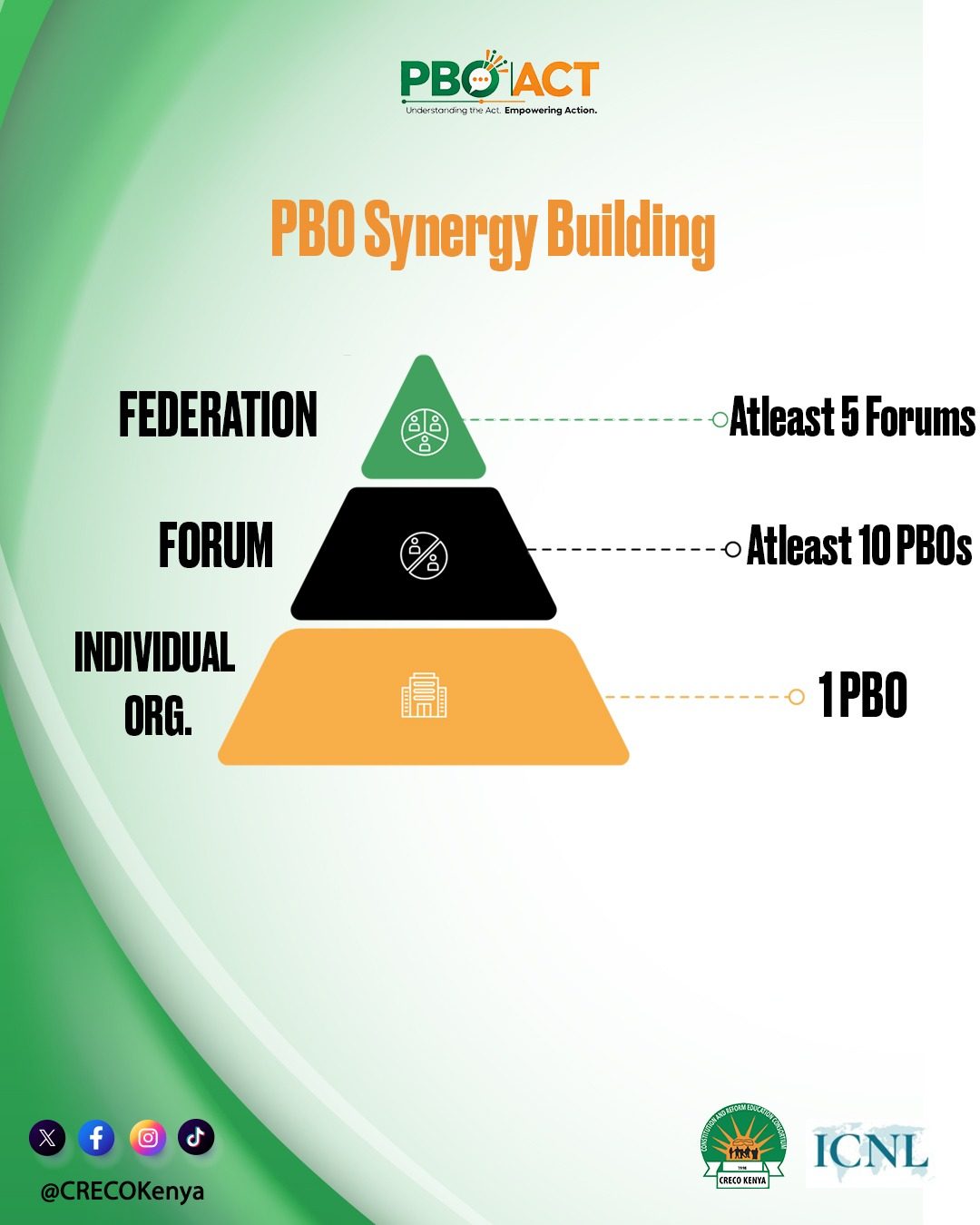
A Federation is generally an umbrella body that brings together several Self-Regulation Forums or networks of Public Benefit Organizations to promote coordination amongst themselves.
While individual self-regulation forums or federations may focus on specific thematic areas of operation, geographical regions or categories of organizations, a National Federation provides broader coordination and representation of the sector at the national level.
This structure enables the sector to engage collectively with government institutions and other stakeholders on matters affecting Public Benefit Organizations.
Recognition by the Authority
The Act provides that Self-Regulation Forums and the Authority shall enter a Recognition Agreement upon proof that the forum represents a significant number of organizations registered by the Authority.
The Regulations provide an outline of requirements that self regulation forums or federations should meet to gain recognition from the Authority. This includes requirements on the minimum number of organizations that the forum or federation should have.
Note: The petition on the case held that Section 23(2) of the , which restricts recognition to self-regulation forums that represent a “significant number” of organizations, violates Article 36 and 24 of the Constitution and is therefore invalid.Recognition does not transform the forum into a regulator. The statutory regulatory mandate remains with the Authority.
Rather, recognised forums complement the Authority in promoting voluntary and strengthening governance across the sector.
Application for Recognition
The Regulations prescribe the procedure for applying for recognition as a Self-Regulation Forum or Federation. A forum must consist of at least ten registered PBOs, while a federation of forums must consist of at least five forums. The constituting members or forums must either engage in related activities under the Sixth Schedule or operate within the same geographical area or region.
Applicants are generally required to submit:
- the prescribed application form and fee;
- The constituting documents of the forum;
- The proof of reservation of the proposed name of the forum;
- A description of the geographical or thematic areas of operation of its members
- The minutes of the meeting where the resolution to form a forum was passed and signed by the office bearers of the members;
- The minutes of the meeting of each member where the resolution to join the forum was passed;
- The particulars of the office bearers of the forum;
- The certificates of of the constituting members of the forum; and
- A code of conduct and standards for the forum
The Authority shall determine the application within sixty days of receipt of the application and may, where the application is approved, issue a certificate of recognition. Where the application is rejected, the Authority should notify the applicant in writing indicating the reasons for rejection.
Codes of Conduct
One of the principal ways that Self-Regulation Forums pursue their goals is through the creation and promotion of codes of conduct.
A code of conduct sets out the ethical and professional standards expected of member organizations
Codes may address matters including:
- integrity;
- accountability;
- financial management;
- conflicts of interest;
- transparency;
- safeguarding;
- anti-corruption measures;
- responsible fundraising;
- respect for beneficiaries; and
- with applicable laws.
Although developed voluntarily, these codes promote consistency and strengthen confidence in the sector.
Peer Learning and Capacity Building
Recognised Self-Regulation Forums play an important role in supporting organizational development. Activities may include:
- governance training;
- legal workshops;
- financial management training;
- sharing best practices;
- mentoring new organizations;
- developing practical guidance materials;
- facilitating networking opportunities.
These activities complement—not replace—the Authority's regulatory role.
Monitoring Compliance among Members
In order to be effective, Self-Regulation Forums may establish mechanisms to encourage with their codes of conduct and internal standards.
These mechanisms may include:
- peer review;
- voluntary assessments;
- advisory support;
- mediation of internal disputes;
- recommendations for corrective action.
However, such forums generally do not possess statutory enforcement powers equivalent to those of the Authority.
Where serious legal violations are identified, matters may need to be referred to the appropriate regulatory authorities.
Relationship with the Regulatory Authority
An important feature of the Act is that it promotes cooperation rather than competition between the Authority and Self-Regulation Forums in ensuring a well governed sector.
The Authority remains responsible for:
- ;
- regulatory oversight;
- investigations;
- statutory ;
- suspension and cancellation of ; and
- enforcement of the Act.
Self-Regulation Forums, on the other hand, contribute by:
- promoting voluntary ;
- strengthening governance;
- encouraging ethical conduct;
- supporting organizational development;
- representing member interests.
The two systems therefore complement each other.
Reporting Obligations
The Regulations require recognised Self-Regulation Forums and Federations to notify the Authority of material changes.
To promote accountability within the forums themselves, it is also important for them to:
- maintain accurate membership records; and
- maintain proper financial records.
Benefits of Self-Regulation
An effective system of self-regulation benefits the entire nonprofit sector.
It helps to:
- improve governance standards;
- strengthen accountability;
- increase public confidence;
- promote responsible use of resources;
- support organizational learning;
- reduce regulatory disputes;
- encourage collaboration;
- enhance the credibility of the sector.
Ultimately, strong self-regulation contributes to a more resilient and trusted civil society.
Common Misconceptions: Is it true that...
"Self-Regulation Forums replace the Regulatory Authority?"
No. The Authority remains the statutory regulator established under the Act. Self-Regulation Forums complement—not replace—its role.
"Membership in a Self-Regulation Forum automatically registers an organization as a PBO?"
No. can only be granted by the Public Benefits Organizations under the Act.
"Codes of conduct have the same legal status as the PBO Act?"
No. Codes of conduct are voluntary standards developed by the sector. They supplement but do not replace statutory obligations.
"Self-regulation means organizations regulate themselves without government oversight."
No. Self-regulation operates alongside statutory regulation. Organizations remain subject to the Act, the Regulations and other applicable laws.
Practical Tips
Public Benefit Organizations should consider participating in recognised Self-Regulation Forums because they provide opportunities to:
- strengthen governance practices;
- stay informed about legal developments;
- access training and peer support;
- improve accountability systems;
- contribute to sector-wide policy discussions;
- build partnerships with other organizations.
Participation demonstrates a commitment to good governance and continuous improvement.
Legal References
Public Benefits Organizations Act, 2013: Part III, including Sections 20–24 (Freedom of Association, Federation and Self-Regulation Forums).
Public Benefits Organizations Regulations, 2026: Regulations 22–25 and 30 (Recognition of Forums and Federations, Application Requirements, and Material Changes), including Forms 11 and 12 in the Second Schedule.
This summary is general information, not legal advice. Read it with the Public Benefit Organizations Act, 2013 and the Public Benefit Organizations Regulations, 2026.