
- The Authority has legal powers to suspend or cancel where organizations fail to comply with the Act.
- These powers must be exercised fairly and in accordance with due process.
- Organizations should receive notice of alleged non- and an opportunity to respond before adverse action is taken.
- Suspension is generally temporary, while cancellation removes an organization from the Register.
- Organizations dissatisfied with regulatory decisions may appeal to the Public Benefits Organizations Disputes Tribunal or apply to the Authority for a review of the decision.
- Strong governance and timely are the most effective means of avoiding enforcement action.

Knowledge hub
Suspension, Cancellation, Appeals and Restoration
Listen to this page
Prefer listening? Play to hear this topic read in a clear voice.
At a glance
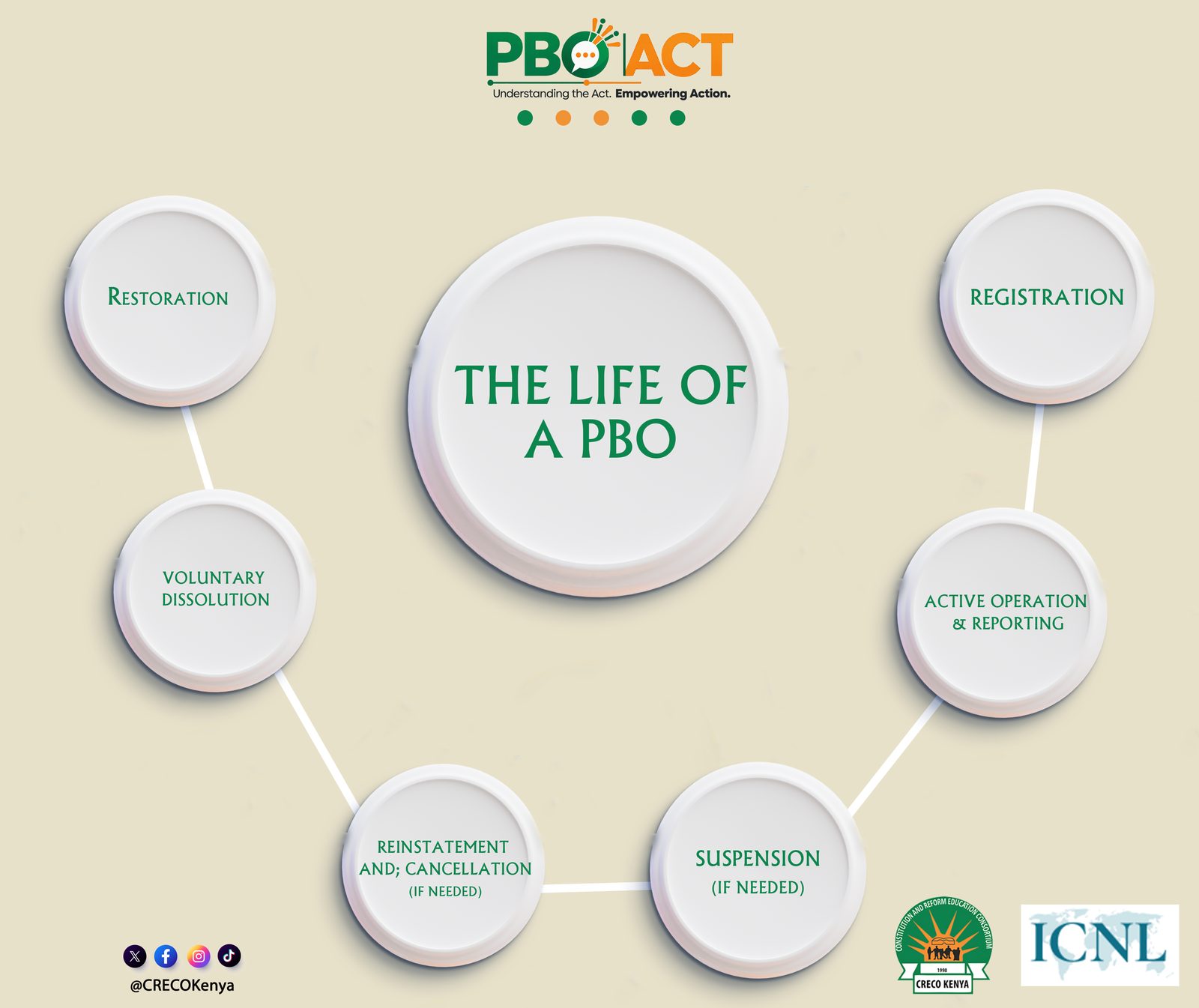
Read the full explanation
Suspension, Cancellation, Appeals and Restoration
Understanding Regulatory Enforcement and Due Process under the Public Benefits Organizations Act, 2013 and the Public Benefits Organizations Regulations, 2026
Why this Summary Matters
The Public Benefits Organizations Act, 2013 establishes an enabling legal framework that supports the work of Public Benefit Organizations while ensuring they are accountable and well governed. However, where a fails to comply with the law, the Public Benefits Organizations (“the Authority”) is empowered to take regulatory action.
These enforcement powers are designed not to penalize organizations for minor administrative errors. Rather, they exist to protect the integrity of the sector, safeguard public trust, and ensure that organizations continue for purposes that benefit the public.
Importantly, the Act also protects organizations from unpredictable regulatory actions by requiring the Authority to observe the principles of fair administrative action and due process. Before taking negative action against a , the Authority must follow procedures prescribed by law and provide the organization with an opportunity to be heard.
This summary explains the circumstances under which may be suspended or cancelled, the rights of affected organizations, the appeal mechanisms available under the Act, and the process for restoring organizations to the register.
Regulatory Oversight and Enforcement
The Authority is responsible for ensuring that Public Benefit Organizations comply with the Act and the Regulations.
To perform this function, the Authority may:
- monitor with the law;
- review reports and returns submitted by organizations;
- conduct inquirieswhere authorised;
- request information and documentation;
- issue lawful directions;
- investigate suspected non-; and
- take enforcement action where necessary.
These powers should always be exercised fairly, reasonably and in accordance with the Constitution and the Act.
Suspension of Registration
Suspension is a temporary step. It means the organization has not been permanently removed yet, but some of its activities or rights may be restricted, till the default is addressed.
Under sections 18 and 19 of the Act and Regulation 16, suspension may be used where the Authority believes the organization has breached the Act, failed to comply with a default notice, or where there is substantial and credible evidence that it has ceased to exist.
Before suspension, the Authority must give the notice and a chance to respond regarding remedy. The periods for under the Act and the Regulations are not aligned. The Act requires the Authority to provide at least 15 days for after the receives the default notice. However, Regulation 16 requires at least 30 days are given for after the notice, before suspension or cancellation is effected.
The difference in the timelines arose because during the public participation sessions on the draft Regulations, stakeholders submitted that the notice period was not sufficient. The final approved Regulations therefore provide more time (at least 30 days) even though the period under the Act (at least 15 days) is still deemed insufficient.
Grounds for Cancellation of Registration
Cancellation is more serious than suspension because it results in the organization’s permanent removal from the register of PBOs.
Under section 19 of the Act, cancellation may occur where a has violated the Act, or there is substantial and credible evidence that it has ceased to exist. Regulation 34 provides that the Authority may deregister a that fails to comply with the Act or Regulations; fails to undertake its public benefit purpose for three years; engages in money laundering or other economic crimes; or contravenes another written law of Kenya. An example of failing to comply with the Act could include governance issues arising from the absence of a functioning governing body. Another example is the misuse of the organization’s resources for personal gain, illegal purposes, or to cause harm.
Cancellation should only be used in cases where the breach is serious or when the organization continues to be non-compliant after receiving warnings, to the extent that it no longer qualifies to remain on the register
Fair Administrative Action
One of the most important safeguards in the Act is the requirement that regulatory action be procedurally fair.
Before suspending, cancelling or deregistering an organization, the Authority should follow these basic steps:
- give the organization written notice of the issue;
- explain the reasons and the legal basis for the proposed action;
- give the organization a reasonable opportunity to respond or correct the problem;
- consider the organization’s explanation or corrective action; and
- communicate the final decision in writing.
Regulation 34 provides that the Authority must, in addition to notifying the organization in writing and specifying the reasons for the intended action, give it a reasonable opportunity to be heard, and specify the remedial steps and timeline for .
This means an organization should be notified about what the default is and have a chance to be heard before the Authority takes final action.
Important Legal Update on Enforcement Timelines: While the Act in section 18(3) currently provides a minimum default notice period of at least 15 days, Regulation 16 requires the Authority to give the organization at least 30 days’ notice to comply before suspension or cancellation.
Petition No. E519 of 2024 on the declared that Sections 18(1), 18(2) and 18(3) of the Public Benefit Organizations Act, 2013 are unconstitutional. These sections violate the right to fair hearing under Article 50(1) of the Constitution because they allow the Authority to suspend or cancel the of a without providing the organization with sufficient opportunity to be heard by an independent and impartial body.
Additionally, Section 19(1)(b) of the Act was also declared unconstitutional for violating Articles 36(3)(a) and 24 of the Constitution. This section of the Act permits unreasonable and unjustified cancellation of a ’s on the ground of acting contrary to its own constitution. This amounts to unreasonable withdrawal of , contrary to Article 36(3)(a) of the Constitution that safeguards the Freedom of Association.
Implication: For practical purposes, organizations should treat the 30-day notice requirement in the Regulations as the standard administrative notice period before suspension or cancellation is effected.
Notice to the Organization
The Regulations complement the Act by prescribing how notices should be issued and communicated.
Generally, notices should:
- be in writing;
- clearly state the nature of the alleged non-;
- specify any corrective action required;
- indicate the applicable timelines for ;
- explain the consequences of continued non-.
Proper notice promotes transparency and gives organizations a meaningful opportunity to remedy issues before more serious enforcement measures are taken.
Opportunity to Remedy Non-Compliance
The legal framework recognises that not every issue warrants cancellation.
Many issues, particularly administrative deficiencies - can be corrected.
Accordingly, where appropriate, the Authority may require an organization to:
- submit outstanding reports;
- update governance records;
- notify material changes;
- amend its governing documents;
- provide missing information;
- take corrective governance measures; or
- comply with other lawful directions within a specified period.
Prompt often prevents escalation to more serious enforcement action.
Effect of Suspension
During suspension, an organization remains in existence but may face restrictions on the exercise of certain rights associated with its .
Regulation 18 sets out specific restrictions during suspension. Unless the law allows otherwise, a suspended may not:
- withdraw money from its bank account except for mandatory legal or statutory obligations;
- undertake activities, projects or investments;
- borrow or lend money;
- dispose of its assets;
- renew or replace its certificate;
- amend its register or change directors or membership particulars; or
- make new investments, including buying assets.
Since suspension can seriously disrupt a ’s day-to-day operations, the affected organization should treat it as urgent.
Effect of Cancellation
Cancellation of has significant legal consequences. Essentially, the organisation loses its legal status or identity. It is no longer recognised as a legal person under the law, and therefore, it has no capacity to carry out any acts necessary for the proper performance of its functions under the Act, and which may be lawfully done by a registered entity.
Once is cancelled:
- the organization loses the rights and benefits that come with ;
- the Authority may remove the organization’s name from the register; and
- require it to stop operations as a ;
- the cancellation will be published in the Gazette and on the Authority’s website;
- the organization remains responsible for obligations that arose while it was registered, including obligations relating to money, assets and reporting.
Cancellation under the does not dissolve an organization that was bestowed status and incorporated under another law. For example, a company limited by guarantee that had been bestowed status would continue to exist under the Companies Act unless separately dissolved under that Act. However, it would lose its recognition as a .
Voluntary Cancellation
Not every cancellation of a PBOs certificate of results from misconduct.
An organization may voluntarily request cancellation where, for example:
- it intends to dissolve;
- it wishes to cease public benefit operations;
- it is restructuring and wishes to register under another legal framework; or
- it no longer wishes to maintain .
The Authority considers such requests in accordance with the Act and the Regulations.
Right of Appeal
In addition to the requirement that regulatory action should be procedurally fair, the also provides PBOs with the right of appeal. Cancellation decisions should be reviewable by a court or independent body.
The recognises that organizations may disagree with decisions made by the Authority.
A person or organization affected by cancellation or suspension of a certificate or permit may appeal to the Public Benefits Organizations Disputes Tribunal within 30 days of the Authority’s decision under Regulation 21.
The Act also allows review by the Authority or appeal to the Tribunal in other cases.
Appealable decisions may include:
- refusal of ;
- cancellation of an exemption permit;
- refusal to restore or reinstate ; and
- other decisions that the Act allows to be reviewed or appealed.
The Tribunal provides an independent mechanism for reviewing decisions rather than resorting to the courts.
The Tribunal is discussed in greater detail in Summary 9.
Restoration of Registration
Where the circumstances leading to suspension or cancellation have been addressed, the Act and the Regulations provide mechanisms through which an organization may seek restoration of its .
Restoration applies where a certificate of or an exemption permit have been cancelled. Under Regulation 19, the Authority may restore an organization where:
- the cancellation was made in error;
- the organization has remedied the reasons for cancellation;
- outstanding obligations have been addressed; or
- the Authority considers that restoration is appropriate.
The application may be made by the Authority, of its own motion or by the affected . It is made using Form 10, and the Authority must determine it within 14 days of receipt.
Reinstatement after Suspension
Reinstatement applies where an organization has been suspended, not cancelled. Under Regulation 20, a suspended may apply to the Authority using Form 10. The Authority must determine the application within 14 days and either reinstate the organization or notify the organization of rejection and give written reasons for refusing the application.
In simple terms: restoration is for cancellation; reinstatement is for suspension.
Common Misconceptions: Is it true that...
"The Authority can cancel registration without informing the organization?"
No. The Act requires procedural fairness. Organizations should be informed of the proposed action and given an opportunity to respond before a final decision is made.
"Minor administrative mistakes automatically lead to cancellation?"
No. The legal framework encourages corrective action where deficiencies can reasonably be remedied. Cancellation is generally reserved for more serious or persistent non-.
"A suspended organization is automatically dissolved?"
No. Suspension is temporary and does not automatically dissolve the organization. The Authority can lift the suspension and reinstate the organization, if the underlying issue or breach is corrected.
"Cancellation under the PBO Act always ends the legal existence of the organization?"
Not necessarily. The effect of cancellation depends on whether the organization was directly incorporated under the . An organization that bestowed status, and that was already incorporated under another law (e.g. the Companies Act)will continue to exist under that law but lose its status. An organization that was established primarily through under the will lose its legal identity and cease to exist.
Practical Compliance Checklist
To minimise the risk of enforced regulatory action, ensure proactive through::
- Submitting annual reports and statutory filings within the prescribed timelines.
- Maintaining proper governance and financial records.
- Notifying the Authority promptly of material changes.
- Responding promptly to correspondence and lawful directions from the Authority.
- Reviewing obligations regularly.
- Seeking legal or professional advice where significant issues arise.
- Keeping copies of all statutory filings and communications.
- Operating strictly within the organization’s approved public benefit purposes; and
- Addressing concerns immediately when notified.
Legal References
Public Benefits Organizations Act, 2013: Sections 17–19 (Review or Appeal, Procedure for Suspension or Cancellation, and Suspension or Cancellation of Certificate); Sections 50–52 (Tribunal Jurisdiction and Powers); Sections 61–63 (Voluntary Deregistration, Safety of Assets and Inquiries); Section 64 (Offences and Penalty).
Public Benefits Organizations Regulations, 2026: Regulations 16–21 (Suspension or Cancellation, Cancellation of Permit, Restrictions during Suspension, Restoration, Reinstatement and Appeals); Regulations 33–38 (Voluntary Dissolution, Deregistration, Safeguarding of Assets and Safety of Assets); Regulation 42 (Penalties); Forms 8, 9 and 10 in the Second Schedule.
This summary is general information, not legal advice. Read it with the Public Benefit Organizations Act, 2013 and the Public Benefit Organizations Regulations, 2026.